

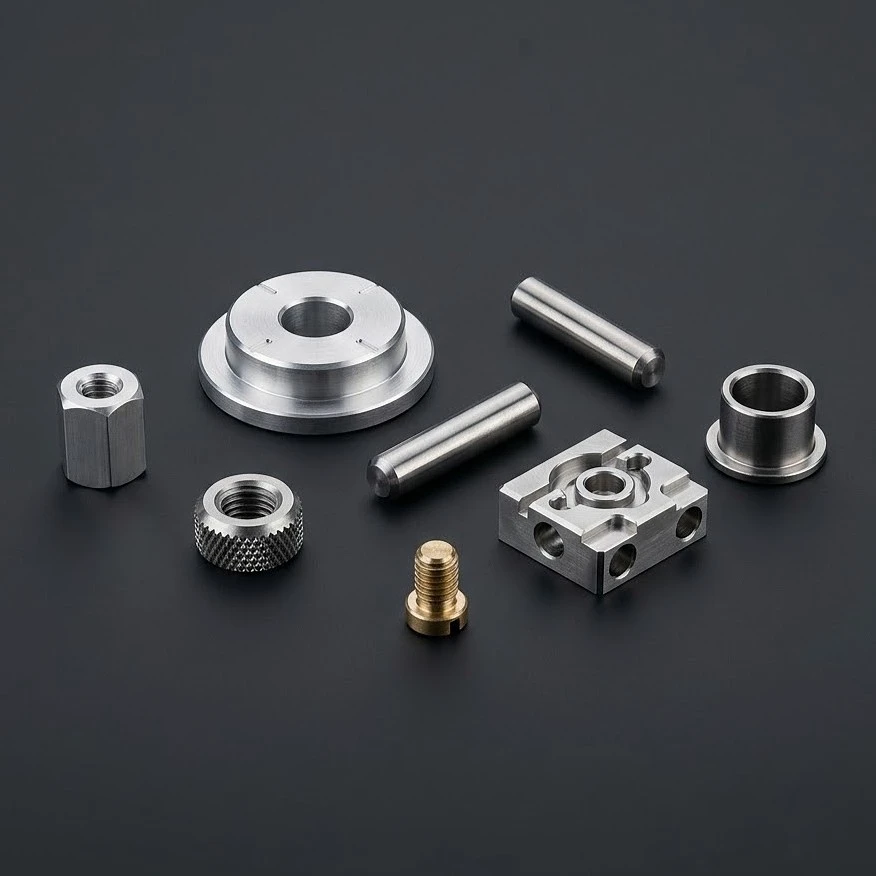
Why precise Edge Counts
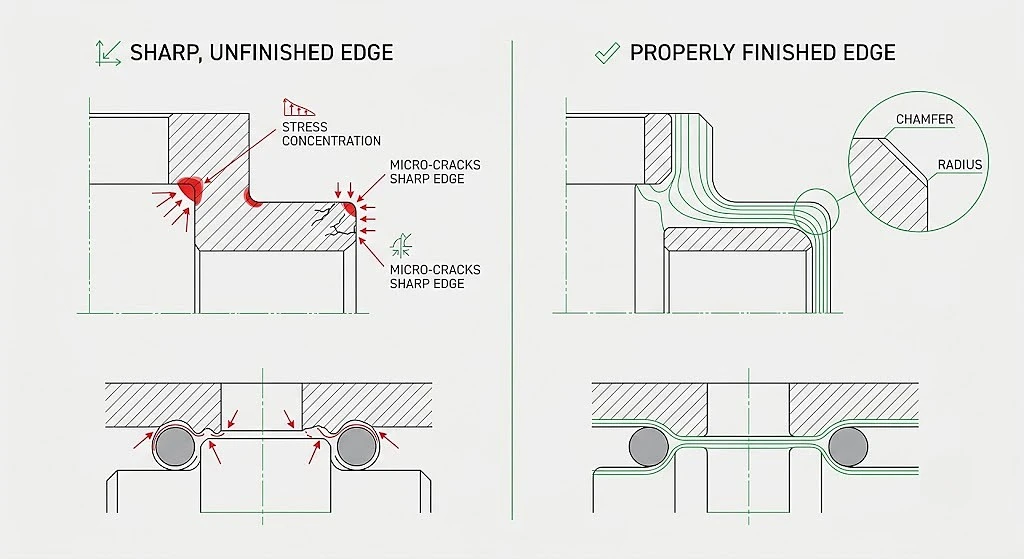
Some machined edges are not "sharp" or "smooth". The actual performance of precise engineering parts is affected by the edge condition. According to ASME structural design guidelines, unfinished edges create areas of stress concentration that decrease fatigue life by 50% in cyclic-loading situations. In sealing systems, an edge defect of as little as 0.05 mm can damage O-ring contact surfaces and result in hydraulic or pneumatic fluid leaks, leading to system failures. Sharp edges have an uneven coating build-up on anodized or plated components. It violates dimensional precision after surface treatment, and causes premature coating cracking during edge transitions.
precise edge finishing services fix these defects prior to field failures. Edge finishing is more than just a deburr of a cut; it controls the geometric character of each edge, choosing break sizes, chamfer angles and fillet radii based on your model. Edge finishing with precision specifies what should be and deburring removes what should not be. Key-CNC combines burr removal and edge engineering to offer clean, safe and dimensionally-accurate products right from the first shipment.
Finishing edges
Depending on the part geometry, the material characteristics and the function, Key-CNC uses different edge finishing processes:

| ■ Edge break (rounding) . All sharp edges controlled to within 0.1-0.5 mm in radius. Edge breaks are the most common mechanical drawing edge finishing specifications. They help to reduce handling injuries, stress and a constant coating thickness in anodising or powder coating. To avoid manual operations and to ensure dimensional consistency from batch to batch, we programme our CNC machines with edge break toolpaths inside machining cycles. | ■ Chamfering. Flat bevels, not rounded shapes, are created by precise 45-degree or custom angled cuts. Chamfers guide pin insertion, prepare welds and determine thread lead-in geometry; We offer precise edge finishing services, providing chamfers with angle tolerances of ±0.5° and dimensions tolerances of ±0.03 mm, optically checked at each point in the production process. |
| ■ Fillet & Radius Finishing. Concave transitions between surfaces are machined to a smooth radius as defined. You require fillets at interior corners transferring stress in structural CNC parts. We use Key-CNC radius gauges and optical comparators to validate fillet radii against design callouts for our edge finishing procedure. All shipments have final inspection reports. | ■ CNC-Programmed Edge Control. Key-CNC integrates the edge geometry to the machining cycle, not as a post-process. Springs are produced with consistent quality on the edge, multi-step chamfer cycles for progressive material removal, and radius-contour finishing on the same 3-axis and 5-axis CNC equipment used to produce the product. This integrated approach ensures edge sharpness is an inherent part of the component, not something added afterwards. |
Edge Finishing Specifications
The table below outlines the edge finishing parameters available at Key-CNC, covering the full range of edge features from micro breaks on medical parts to structural fillets on heavy-duty components:
|
Edge Feature |
Size Range |
Tolerance |
Typical Application |
|
Edge Break |
0.1–0.5 mm R |
±0.05 mm |
General safety, coating uniformity |
|
Chamfer (45°) |
0.2–3.0 mm |
±0.03 mm |
Assembly lead-in, weld prep |
|
Chamfer (Custom) |
0.2–5.0 mm |
±0.5° angle |
Thread entry, sealing surface |
|
Fillet Radius |
0.5–6.0 mm R |
±0.05 mm |
Stress distribution, structural parts |
|
Micro Edge Break |
0.05–0.15 mm R |
±0.02 mm |
Medical, optical, electronic parts |
|
Full Radius |
Per drawing |
±0.03 mm |
Fluid flow, aerodynamic surfaces |
Materials We Finish Edge
Key-CNC offers precise edge finishing services for the whole spectrum of CNC machined materials, each with its own tooling techniques and process parameters. Edge quality is just as much about how the material behaves as it is about how the toolpath is programmed:
Light weight edge breaks and chamfers important for prep for anodising; regulated feeds minimise edge smearing on soft alloys
Work-hardening controlled by multi-pass edge-finishing with progressive tool engagement and carbide cutting edges
High-force regulated chamfers for medical and aerospace applications and edge finishing in conjunction with CNC turning and milling cycles
Low damage edge finishing to reduce fibre fraying and delaminations. Diamond coated tooling for clean fibre trimmed edges
Brass & Copper
Soft-abrasive edge finishing, retaining conductivity and dimensional accuracy; chamfer angles maintained without surface deformation
Hardened Steels (440C, D2)
Carbide tooling at controlled feed rates for precision edge finish; chamfers are machined after hardening for geometric accuracy
Edge Finishing Before Anodizing
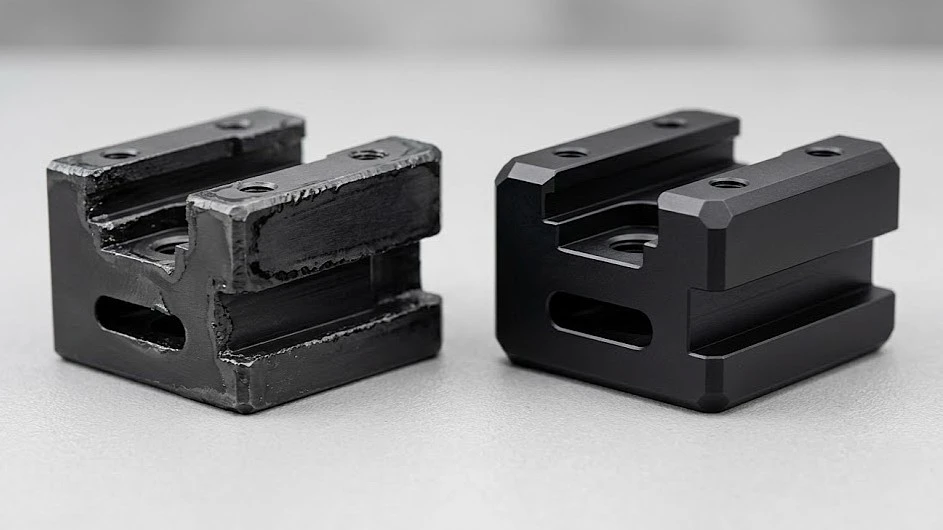
Edge condition and surface treatment results are typically overlooked in CNC part quality. Sharp edges cause uneven oxide layer accumulation during Type II ornamental or Type III hardcoat anodising. On 0.005 mm radius edges, anodic coatings can grow 2–3 times their nominal thickness, interfering with mating surfaces and thread profiles. Accumulation is a major issue in Type III hard anodising, as the 25-100 μm coating thickness worsens edge flaws and tolerance breaches
Edge finishing by breaking edges before surface treatment solves this. Prior edge preparation improves coating dispersion, colour consistency, and dimensional compliance following finishing. According to our Type III anodising service page, Key-CNC engineers evaluate pre-anodizing design and recommend edge break sizes for harsh anodising coatings' 50% outward development. For parts requiring selective edge treatment, precision masking keeps thread entrances, grounding surfaces, and press-fit contact zones sharp while breaking all other edges to specification.
Key-CNC's key industries
-robotics and automation, medical devices, sports and outdoor equipment, automotive
-benefit from precise edge finishing services, which improves performance, safety, and reliability.
These sectors benefit from accurate edge control, which increases assembly accuracy, stress concentration, sealing performance, and crucial component compliance with strict engineering and safety regulations.
Quality and Inspection Process
Every edge finishing order at Key-CNC follows a documented inspection workflow aligned with our ISO 9001:2015 certified quality management system. Edge quality is not assumed - it is measured, recorded, and verified at defined checkpoints throughout the production cycle.
Hot Tags: precise edge finishing services, China precise edge finishing services manufacturers, suppliers, factory, deburring, Deburring Finishes Service for Custom Machined Parts, Deburring Tool with High Speed Steel, Manual Automated Deburring for Metal Parts, Metal Parts Deburring Process Service


