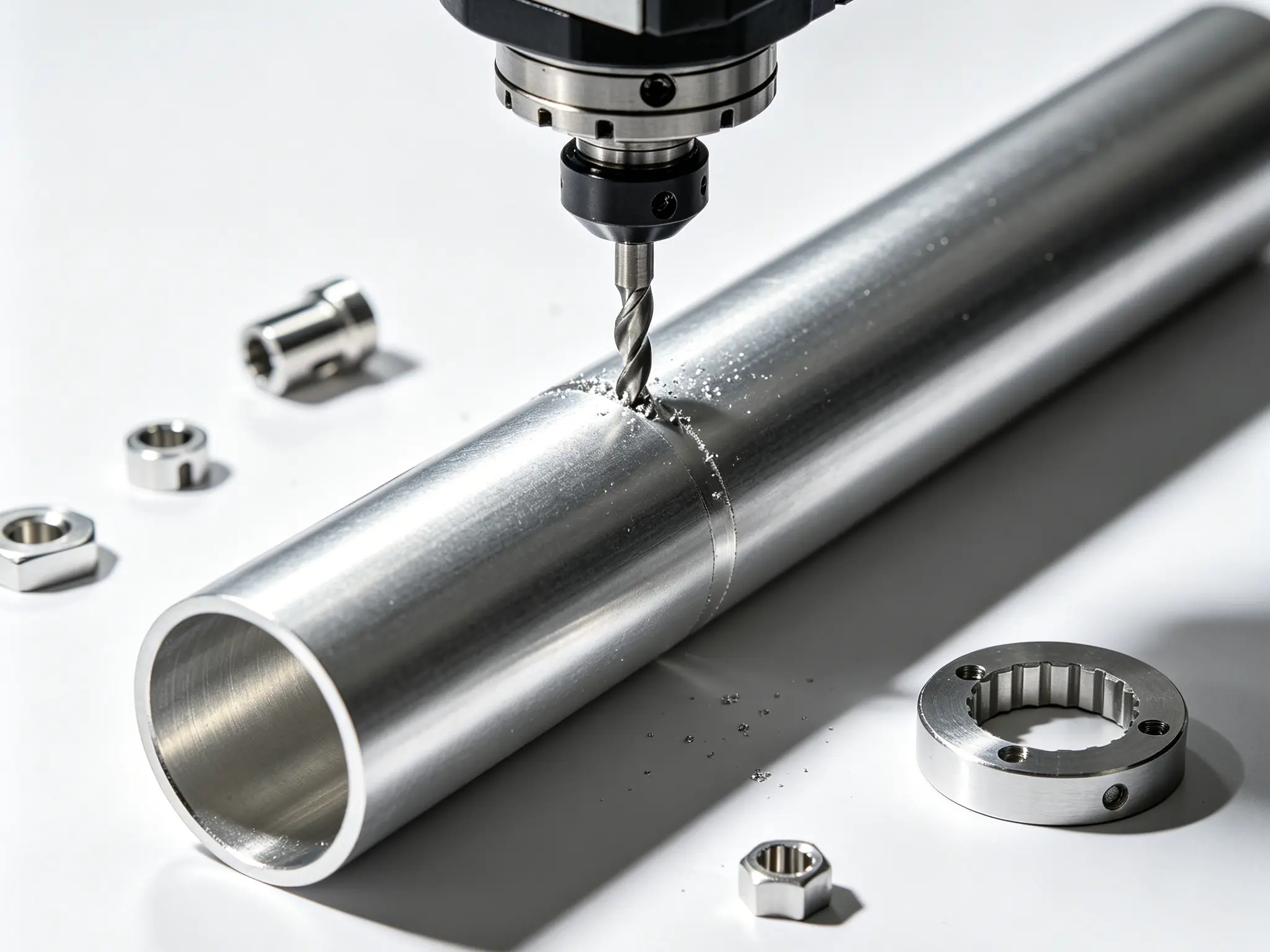
What Is Type II Anodizing ?
Sulfuric-acid electrochemical type II anodizing generates a regulated, porous aluminium oxide coating on 6000- and 7000-series aluminium alloys. The coating thickness ranges from 0.002″ to 0.010″ , achieving the ideal balance between protection and precision. Even after thermal cycling, the oxide layer cannot peel or flake because it is intrinsic to the underlying metal.
MIL-A-8625 defines anodizing into three types: Type I (chromic acid), Type II (sulfuric acid), and Type III (hardcoat). The "Type II" name derives from this specification. Commercial and industrial CNC aluminium parts that need function and beauty are most often anodized using Type II.

Type II Anodizing vs. Other Types
Choosing the right anodizing type depends on your part's service environment and visual requirements.
The table below highlights the key differences:
| Electrolyte | Chromic acid | Sulfuric acid | Sulfuric (low temp) |
| Coating thickness | 0.002–0.01″ | 0.02–0.1″ | 0.1–0.4″ |
| Color options | Very limited | Wide range (dyed) | Limited (dark only) |
| Key advantage | Minimal dimension change | Best cost-to-performance | Extreme wear resistance |
Type II Anodizing Service Process Step by Step
Every component that undergoes our anodizing process goes through a meticulously designed, seven-step procedure to ensure that the finish is uniform and adheres properly.
Step 1: Use an alkaline etch after doing some cleaning.
Eliminate all surface dirt, coolants, and grinding oils.
Additionally, etching reduces the surface's micro-roughness, which facilitates the more uniform formation of oxide.
Step2:Desmutt
Intermetallic particles like silicon, copper, and manganese that could alter the colour or make it more difficult
for the dye to adhere are eliminated by a dip in nitric or sulfuric acid.
Step 3: anodizing (a sulfuric acid bath)
Metal fragments are employed as anodes in a 15–20% sulfuric acid solution maintained at 20–25 °C during the core stage.
The oxide builds up to the proper thickness when the voltage (12–24 V DC) is applied.
Step 4: Dye it for fun.
Both organic and inorganic pigments are well absorbed by the porous oxide.
We can match any RAL or Pantone hue to your needs, and we have a collection with over forty basic shades.
Step 5: Nickel-acetate sealing.
Hydrated nickel acetate fills and plugs the perforations at 90 to 98 °C.
This strengthens the dye's resistance to corrosion and protects it.
There are alternative cold-seal (nickel-fluoride) techniques that can be applied to items with extremely tight tolerances.
Step 6: Verify the quality.
An eddy-current gauge is used to measure the coating's thickness.
Additionally, samples from every batch are examined for UV fading and salt spray (ASTM B117).
Step 7: Complete the package and mail it.
To prevent surface damage during shipping, parts are placed in sturdy cases and wrapped in anti-abrasion paper.
Key Benefits of Type II Anodizing Service
CNC aluminium products with Type II anodizing Service provide longevity benefits:
Resistant to corrosion
The sealed oxide layer is resistant to moisture, salt spray, and industrial chemicals. Type II coatings that are properly sealed can withstand 336-1,000 hours of ASTM B117 salt-spray testing for marine and outdoor applications.
Decorative Flexibility
Type II anodizing enables for vivid colours such as signal red and electric blue while maintaining a metallic gloss that paint cannot match. Type III accepts only dark, matte tints.
Electrical Insulation
Aluminium oxide is a dielectric. Anodized surfaces eliminate the need for non-conductive coatings in assemblies that require precise separation between conducting elements.
Dimensional Stability
There is no heat-affected zone because the process is electrochemical. Type II protects precision-machined features (±0.05 mm tolerances) without compromising fit.
Cost-effectiveness
Type II anodizing consumes less energy and electrolyte than Type III and has a 24-48-hour turnaround time, keeping your supply chain efficient.

Common Applications of Type II Anodizing
CNC aluminium parts are typically finished with type II anodizing service. Because of its combination of looks, protection and precision, it's standard in dozens of industries.
Consumer electronics - housings, heat-sink housings, button panels
Automotive - sensor brackets, interior trim parts, fluid caps
Medical Devices – Diagnostic Equipment Casings, Handheld Instrument Casings
Architectural hardware - window frames, railing parts, decorative trims
Sporting goods – bicycle stems, fitness equipment handles, scope mounting
Why Choose KEY-CNC for Type II Anodizing
Not all anodizing providers deliver the same quality. At KEY-CNC, we combine in-house CNC machining and finishing under one roof, eliminating the logistical risks of separate subcontractors. Our anodizing line is integrated with real-time electrolyte monitoring, ensuring every batch meets MIL-A-8625 and RoHS compliance.
We also offer rapid-turn prototyping - as fast as 3 days from CAD to anodized part - and seamless scaling to volume production (10,000+ units/month). Every order is backed by a full material cert and dimensional inspection report at no extra charge.
* In-house CNC + anodizing = single-source accountability
* 40+ standard colors, custom RAL/Pantone matching
* Salt-spray testing up to 1,000 hr available
* RoHS, REACH, and ISO 9001 certified
* Global shipping from our Shenzhen production hub


| Technical Item | Specification |
|---|---|
| Process standard | MIL-A-8625 Type II, Class 1 (undyed) / Class 2 (dyed) |
| Compatible alloys | Al 6061, 6063, 7075, 5052, 3003 (others on request) |
| Coating thickness | ±0.3 mm tolerance |
| Color options | 40+ standard dyes; custom RAL/Pantone matching |
| Sealing method | Nickel-acetate hot seal (standard); cold seal available |
| Max part size | 1,200 × 600 × 500 mm (custom racking for larger parts) |
| Salt-spray life | 336 hr (standard seal); 1,000 hr (premium double seal) |
| Lead time | 3–5 days (prototype); 7–10 days (production) |
Frequently Asked Questions
Q: Can Type II anodizing be applied to threaded holes?
A: Yes, but masking or careful racking is required to prevent bridging. For critical threads we recommend mask plugs; alternatively, we can re-tap after anodizing.
Q: Does anodizing affect dimensional tolerances?
A: The oxide layer grows approximately 50% outward and 50% inward. For tight-tolerance features, we compensate in the pre-anodizing CNC program.
Q: Is dyed Type II anodizing UV-stable?
A: Standard organic dyes may fade after prolonged UV exposure. For outdoor applications we recommend inorganic dyes or our premium double-seal process.
Q: Can I combine anodizing with other finishes?
A: Absolutely. Bead blasting before anodizing creates a uniform matte surface; laser engraving after anodizing produces high-contrast logos and part numbers.
Hot Tags: type ii anodizing service, China type ii anodizing service manufacturers, suppliers, factory, anodizing, CNC Machining Anodizing Services for Aluminum, Custom Anodized Aluminum Parts, Metal Surface Finishing Services for Enhanced Performance, OEM Anodized Aluminum Parts for Universal Use, Protective Aluminum Anodizing Hard Coating Service