

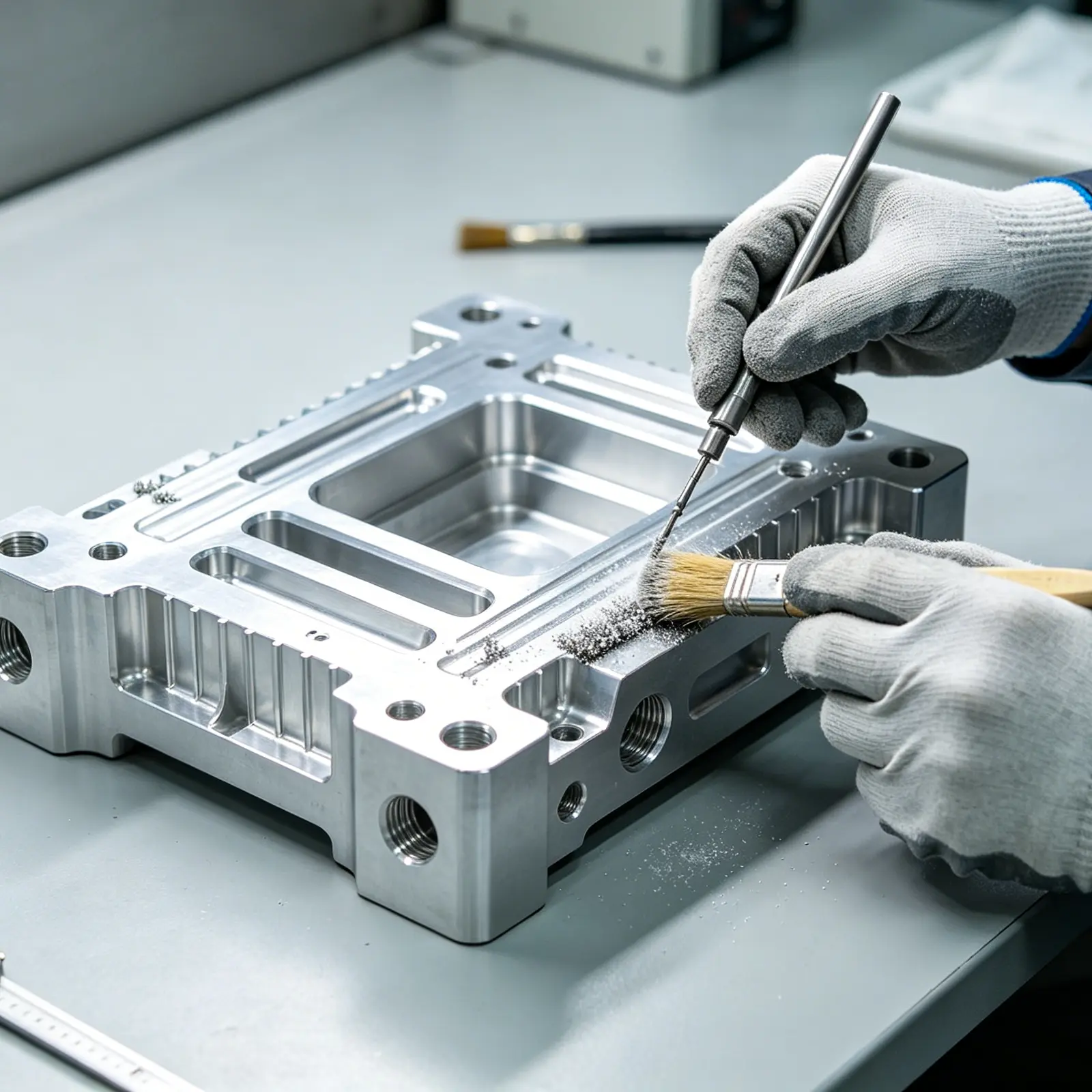
Controlled Manufacturing Approach for Burr Elimination
The deburring process is typically carried out right after CNC milling or CNC turning, and always before surface finishing steps such as anodizing or passivation. This order matters because burr formation is highly dependent on material behavior-stainless steel often produces harder, work-hardened edges, while aluminum usually forms softer rollover burrs that still require controlled removal.
For external geometries, we use controlled abrasive brushing and fine micro-cutting methods to remove burrs without affecting the original dimensions or edge definition. Features such as internal cross-holes and intersecting channels are handled with dedicated tools designed to reach constrained areas, ensuring consistent results even in deep or complex cavities. In CNC tapped threads, the cnc deburring service is applied carefully to clean the thread root while keeping the thread profile intact, maintaining stable torque performance and smooth fastener engagement.
Dimensional control is kept within ±0.01–0.1 mm depending on the function of the part. For critical sealing surfaces and bearing interfaces, each feature is inspected under magnification to confirm that no residual burrs remain before the part moves into any downstream finishing process.

Engineering Performance Advantages
Reduce Fatigue and Stress Concentration
Sharp, unconditioned edges act as geometric stress concentration points under cyclic loads. Our process ensures smooth, controlled edge radii, significantly reducing the risk of micro-cracking and accelerating fatigue life in high-load structural components.
Stable Fit in Robotics Assemblies
Micro defects in high precision robotics systems and motion assemblies destroy crucial contact conditions between housings and bolts. We reduce these differences for good alignment, constant torque retention and faultless mechanical repeatability.
Better Coating and Surface Adhesion
Residual burrs cause uneven current density during anodizing and chemical shielding during passivation. By providing pristine, edge-conditioned surfaces, we ensure that post-treatments adhere uniformly-preventing edge buildup, thinning, or premature coating peeling.
From Prototype to Production Without Variation
Whether you're building a complex CNC machining prototype or doing a Low Volume CNC Tapping Service, our comprehensive approach will ensure your parts arrive at downstream assembly with zero dimensional deviation.

Where It Makes a Difference
In robotics manufacturing, precision burr removal services are essential for actuator housings, encoder mounts, and gear interfaces where smooth motion is required without interference from edge defects. Clean internal channels also ensure that lubrication pathways remain unobstructed.
For medical devices, burr-free deburring process control is critical in diagnostic housings and surgical instrument components where contamination risk must be minimized and sterilization cycles repeated without degradation of surface integrity.
In sports equipment, especially in hybrid structures made of lightweight aluminium or carbon-fibre, the importance of good cnc deburring service may be seen in the increase of fatigue resistance under cyclic loading circumstances such as vibration, impact or repeated mechanical stress. Outdoor hardware systems have no micro-crevices to trap moisture and debris, therefore there are fewer sources of corrosion.

Why It Works in Production Manufacturing
Our approach eliminates erratic, manual benchwork. Instead, precision burr removal services are engineered directly into our automated precision CNC machining workflow to guarantee absolute edge uniformity. By systematically pairing deburring parameters with critical machining variables-such as feed rate, tool wear, and material hardness-we establish a highly reproducible process optimized for both a complex CNC machining prototype and high-volume production runs.
This data-driven integration delivers tangible manufacturing stability:
Minimizes Batch-to-Batch Volatility: Tightly controlled processing ensures that every functional edge behaves predictably during downstream assembly, preventing mechanical interference.
Maximizes Production Throughput: Eliminating secondary manual rework and redundant human inspection cycles drastically reduces lead times and lowers overall production costs.
Secures Dimensional Integrity: Within our advanced CNC metal parts processing facility, deburring is never treated as an optional cosmetic afterthought; it is a fundamental operation that dictates the ultimate dimensional accuracy and tolerances of the component itself.
Frequently Asked Questions
How do I know if my CNC parts actually need deburring?
+
-
If your parts involve mating surfaces, threaded holes, sealing interfaces, or automated assembly, burrs are almost always functionally critical rather than cosmetic. Even small burrs can cause misalignment, insertion resistance, or inconsistent torque behavior during assembly.
Will burr removal change my part dimensions or affect tight tolerances?
+
-
When properly controlled within the deburring process, material removal is extremely minimal and localized at edge transitions. Critical dimensions and functional tolerances (typically ±0.01–0.1 mm depending on geometry) remain unaffected when deburring is integrated into the CNC workflow rather than done aggressively after machining.
What problems usually happen if burrs are not properly removed?
+
-
Common issues include assembly interference, scratches on mating components, poor sealing performance, inconsistent fastener torque, and increased wear in moving assemblies such as robotic joints or sliding mechanisms.
Can all internal features like deep holes and threaded sections be reliably deburred?
+
-
Yes, but the approach depends on geometry. For deep cavities, intersecting channels, and CNC tapped threads, we use specialized tools and controlled techniques to ensure burr removal without damaging thread profiles or internal surfaces.
Is deburring necessary before anodizing or coating?
+
-
Yes. If burrs remain before surface treatment, coatings may build unevenly at edge areas or fail to adhere properly. Completing precision burr removal services before anodizing or plating ensures stable coating thickness and long-term surface performance.
Hot Tags: precision burr removal services, China precision burr removal services manufacturers, suppliers, factory, deburring, Deburring Finishes Service for Custom Machined Parts, Deburring Tool with High Speed Steel, Manual Automated Deburring for Metal Parts, Metal Parts Deburring Process Service


