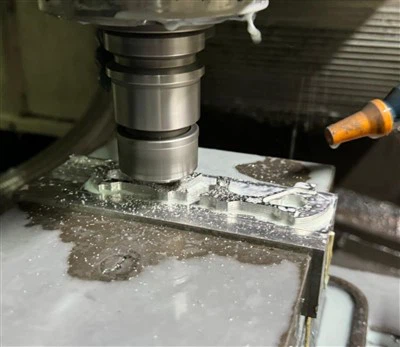
Reasons to Use Stainless Steel CNC Machining Parts
When a part must resist moisture, chemicals, heat, or daily wear, engineers choose stainless steel. Since durability, sanitary, and corrosion-free surfaces are more important than weight, stainless steel is better than aluminium for thermal and lightweight applications.
Choosing stainless steel for CNC parts gives you:
* Chromium creates a self-healing passive oxide layer that resists rust, water, salt, and many chemicals.
* Hardenable grades attain very high hardness, and stainless keeps its mechanical qualities under load and for lengthy service life.
* Heating and chemical resistance-stable at several temperatures and resistant to strong chemical and food processing media.
* Easy-to-clean, non-porous, and passivation and electropolishing-compatible surfaces for the toughest hygienic standards.
* A quality finish-brushed, bead-blasted, or mirror-polished steel looks and performs well.
If your design instead prioritizes light weight or a coloured anodized finish, see our Precise Aluminum CNC Machining. For everything that demands corrosion resistance and toughness, stainless steel is the right call.
We Machine Stainless Steel Grades
Selecting the appropriate grade is half the work. For your application, the "best" stainless is the one that strikes a balance between strength, machinability, and resistance to corrosion. The families that we machine most frequently are listed below, along with where each one fits.
| Grade | Key strength | Typical parts | Relative machinability |
| 303 | Free-machining | Shafts, fittings, fasteners | Excellent |
| 304 / 304L | All-round corrosion resistance | Brackets, enclosures, food parts | Fair |
| 316 / 316L | Chloride / marine resistance | Marine, medical, chemical parts | Fair to challenging |
| 416 | Best machinability + hardenable | Screws, gears, valve parts | Excellent |
| 410 / 420 | Hardenable, magnetic | Valves, blades, instruments | Good |
| 440C | Very high hardness | Bearings, blades, wear surfaces | Challenging |
| 17-4 PH | High strength + corrosion | Aerospace, medical, shafts | Fair |
| 2205 | High strength + SCC resistance | Oil & gas, marine, chemical | Challenging |


Stainless Steel Machinability: Obstacles and Solutions
Aluminium cuts more easily than stainless steel. It is one of the more difficult materials to machine, and the ability to consistently produce precision parts from it is what sets a skilled shop apart from a generic one. The first step to managing the difficulties is to comprehend them.
The difficulties
* Hardening of work. At the cut, austenitic grades (304, 316) harden quickly. A tool's finish and tool life are destroyed when it rubs or stays in place rather than cutting.
* Low ability to conduct heat. Tool wear is accelerated by stainless because it retains heat at the cutting edge rather than transferring it to the chip; 316 is particularly heat-prone.
* Gummy chips and an integrated edge. If speeds, tooling, and coolant are not adjusted, the material has a tendency to weld to the cutting edge, deteriorating surface finish.
* Long, stringy chips and high cutting pressures. To prevent noise and deflection, rigidity and appropriate chip control are crucial.
How we manage them
* Rigid fixtures and setups to prevent tool deflection and vibration.
* Sharp, coated carbide tools made especially for stainless steel, like TiAlN.
* Appropriate, steady feeds and speeds that prevent the surface from work-hardening by keeping the tool cutting without rubbing or dwelling.
* To remove heat from the edge and remove chips, use high-pressure flood coolant.
* To control chip load and remove deep holes, use peck drilling and climb (down) milling.
From prototype to production, the end product is burr-controlled, dimensionally precise stainless steel components with the surface finish your application needs.
Our Capabilities of Stainless Steel CNC Machining Parts
We machine stainless steel parts complete and in-house, matching the process to the geometry:
CNC milling (3-, 4-, and 5-axis)
for complex housings, brackets, manifolds, and contoured features. See our 5-Axis CNC Machining Service for parts that need all features cut in a single setup.


CNC turning
for shafts, fittings, valve bodies, and round components, including live tooling for combined milling-and-turning work - see CNC Lathe Milling Machining Parts Service.
Drilling, reaming, and threading
including thread milling and tapping for stainless - see CNC Tapped Components.


Wire EDM
for hardened and precipitation-hardening grades where conventional cutting is impractical.
Because stainless work-hardens and runs hot, we set tolerances and toolpaths with the material's behavior in mind. Typical capability is summarized below.
| Capability | Stainless steel detail |
| Grades | 303, 304/304L, 316/316L, 410, 416, 420, 440C, 17-4 PH, 2205 |
| Processes | 3/4/5-axis milling, turning, drilling, threading, wire EDM |
| Standard tolerance | ISO 2768-mK; tighter on critical features |
| Tight tolerance | Down to ±0.05 mm where functionally required |
| Surface roughness | As-machined Ra 1.6–3.2 µm; finer with finishing |
| Part size | From small turned parts to large milled components |
| Order volume | Prototype, low-volume, and full production runs |
Stainless Steel Surface Finishing
Stainless steel cnc machining parts are barely half completed. The correct post-process prevents corrosion and gives your application a clean look. Passivation and electropolishing are stainless steel-specific, not aluminium anodising.

As-machined-the normal tool-finished surface for many functioning items.
Bead blasting-a matte finish that masks tool marks.
Brushed/satin-a directional grain (like #4) for industrial, ornamental effect.
Mirror polishing gives luxury and hygienic parts a brilliant look.
Nitric or citric acid passivation (ASTM A967) eliminates buried free iron and enhances the chromium-oxide passive layer. This is essential for post-machining corrosion resistance.
Electropolishing eliminates a tiny surface layer, deburrs, smooths, and enhances corrosion resistance and cleanability for medical, pharmaceutical, and food applications.
PVD coatings-black or gold durable ornamental or wear-resistant coatings.
Permanent part numbers, logos, and traceability indications by laser engraving.
Stainless Steel vs. Aluminum vs. Brass: Choosing the Right Material
Material choice drives cost, weight, and performance more than almost any other decision. Use this quick comparison to confirm stainless is right for your part - or to identify a better fit.
| Property | Stainless steel | Aluminum | Brass |
| Weight | Heavy (~8.0 g/cm³) | Light (~2.7 g/cm³) | Heavy (~8.4 g/cm³) |
| Strength | High | Moderate (great strength-to-weight) | Moderate |
| Corrosion resistance | Excellent | Good (better when anodized) | Good |
| Machinability | Fair to challenging | Excellent | Excellent |
| Relative cost | Higher | Lower | Moderate |
| Best for | Corrosion, strength, hygiene | Lightweight, thermal, cosmetic | Electrical, plumbing, decorative |

Need light weight or a coloured finish instead? Explore our aluminum options, including CNC Machining Aluminum Parts With Custom Colors. For maximum corrosion resistance and durability, stainless steel remains the strongest choice.
Stainless Steel CNC Machining Parts Uses


Stainless steel is utilised for corrosion resistance, hygiene, and load reliability. Customers use stainless CNC parts:
Food, beverage, and dairy-304/316 food-grade, easy-to-clean processing and packaging equipment.
Marine and outdoor hardware-316 and 2205 chloride-resistant fittings, brackets, and fasteners.
Medical and surgical-passivated or electropolished 316L, 17-4 PH, and 440C instruments, fittings, implants.
Petrochemical valve bodies, pumps, fittings, and manifolds resist severe media.
Consumer and architectural products-brushed, polished, or PVD-finished visible sections.
FAQ
Q: Should I choose 304 or 316 stainless steel?
A: 316/316L is a good choice for salt water, chlorides, marine, medicinal and chemical environments because of the additional molybdenum. 304/304L is fine for general purpose parts when the exposure is not too severe. It is cheaper and machines a bit easier.
Q: What are the differences between 303 & 304 for machining?
A: 303 is a free-machining grade – it machines faster, it has tighter chip control, and it reduces cost, which is perfect for big volume turned parts. 304 is tougher to process, but it has higher corrosion resistance and weldability. We will assist you choose by considering the importance of machinability and corrosion performance.
Q: Do you passivate parts after machining? Why is this necessary?
A: Yes. Small amounts of free iron are embedded in the surface during machining and handling and this can rust. Passivation (ASTM A967) chemically eliminates that free iron, enhancing the chromium-oxide passive layer and restoring full corrosion resistance.
Q: Do you machine hardened or precipitation hardening grades such as 17-4 PH and 440C?
A: Yeah. We machine the provided condition and heat-treat or age afterwards, or machine prehardened material. Features that are impractical to cut normally are wire EDM.
Q: Does machining affect corrosive resistance of a part?
A: Yes, temporarily. Surface pollution and imbedded iron can decrease it. Passivation (and electropolishing, where specified) restores and even improves corrosion resistance on the completed product.
Hot Tags: stainless steel cnc machining parts, China stainless steel cnc machining parts manufacturers, suppliers, factory, CNC Machinable Materials and Processing Flow, CNC Machine Setups and Parts Orientation, cnc machining, CNC Machining Of Metal Parts, CNC Machining Services Apply To Parts Made Of Various Metals Materials, One Stop CNC Machining Service