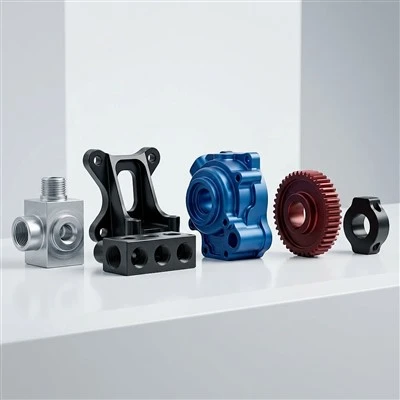
Hello! I offer services such as CNC machined parts in a variety of metals. Today I want to explain to you about how we verify straightness in our CNC machining services.
Straightness in Metal Parts: Why It Matters
But before we dive into the ways, let's first understand why straightness is such a critical deal. The straightness of metal parts can have a direct effect on the performance and safety of the final product, notably in several industries such as aerospace, automotive and medical. For example, it can induce vibrations, and cause early wear and tear and possibly catastrophic failures in an aviation engine with a slightly bent shaft. So it's incredibly vital to get that straightness.
CNC Machining for Metal Parts:
The Basics CNC (Computer Numerical Control) Machining is a manufacturing method by which pre-programmed computer software controls the movement of factory tools and machinery. CNC machining of metal goods offers exceptional accuracy and reproducibility. Our CNC machines are very advanced and can work with many different metals like steel, aluminium and titanium.
Factors affecting straightness of metal parts
There are also a few factors that can affect the straightness of the metal parts during CNC machining.
Material Properties Various metals have different characteristics, such as hardness, ductility, and heat conductivity. These characteristics can influence the behaviour of the metal during machining. For example a really hard metal may be more difficult to mill directly because it may cause more wear on the cutting blades and it can cause vibrations. Whereas a ductile metal might flex more easily and this might also effect the straightness.
Tools for Cutting
The straightness depends primarily on the quality and kind of cutting tools utilised. A non-straight part might be the consequence of dull or worn out cutting equipment causing uneven cutting. We always use and replace good quality cutting tools frequently to keep them sharp.
Mechanical accuracy
The accuracy of the CNC machine itself is significant. If a machine is out of true or out of calibration it will make parts that are not straight. We periodically tune our CNC machines for precision. Which involves checking the linear guides, ball screws and other pieces to ensure they are working properly.
Straightness Preservation Methods
Now, we will discuss the methods we use for straightening the metal parts.


Precision Programming
One of the key steps is precision programming. We create complete machining programmes with state of the art CAD/CAM software. These software consider the material properties, the form of the part and the cutting parameters. We could programme the tool tracks accurately, so that the cut will be as straight as possible. For example we can make straight cuts with linear interpolation and we can optimise the cutting process by altering the feed rate and the spindle speed.
Fixturing & Workholding
For milling, you need the right fixtures and work holding to keep the product straight. We use specially engineered fittings to hold the metal part firmly in place. These fasteners are goal is to hold the part and to keep it from vibrating through the entire cutting operation. For example, we may use clamps , vises or vacuum chucks to hold the part securely .
In Process Inspection
Also we do in-process inspection to make sure the straightness of product while machining. We use accurate measurement equipment, such as callipers, micrometres and coordinate measuring machines (CMMs). The machining technique will be adapted as appropriate and we will check the part for dimensions and straightness on a regular basis. For example, if we notice the section starting to depart from the expected linearity, we can adjust the cutting parameters or the tool path.
Inspection post machining
Once the machining is done we undertake a final after machining check. This is done by using more refined measuring devices to verify that the part meets the prescribed straightness requirements. We compare the measured values to the design specs and if the part does not fit the criteria we may re-machine it or discard it if it cannot be corrected.
CNC Machining Service
We offer a wide range of CNC Machining Services for Metal Parts. Our services are not only limited to simple machining, but also more complicated operations. As an example, 5 Axis CNC Machining Service For Complex Aluminium Parts. This unique method allows to make parts with complex shapes, while maintaining a remarkable straightness and precision.
Prototype & Production CNC Machining w/ DFM Support. Our Design for Manufacturing (DFM) service helps our customers optimise their part designs for the CNC machining process and helps to assure the straightness and quality of the final parts.
Conclusion
CNC machining of metal parts is a complicated process in which many elements must be taken into account, such as quality of material and machine precision. We can produce high quality metal parts with excellent straightness with the right fixturing, in-process and post-machining inspection and accurate programming.
If you are seeking for high quality CNC machined metal parts we would love to talk with you. Whether you're developing a small prototype or a large-scale production project, we have the knowledge and tools to deliver on your objectives. Contact us today to discuss your demands and let's engineer the right metal parts for your application.

Professional CNC Machining Factory
Key-CNC has about 16years more experience in CNC machining. OEM/ODM Service is welcomed. More other needs, contact us freely.