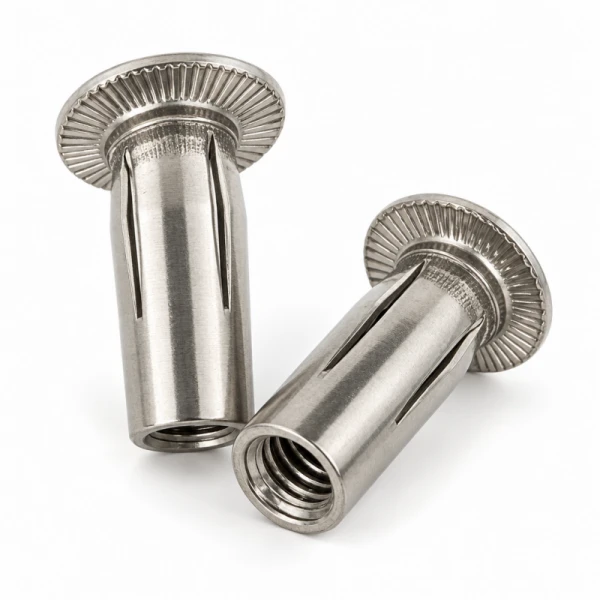
What's a Plusnut?
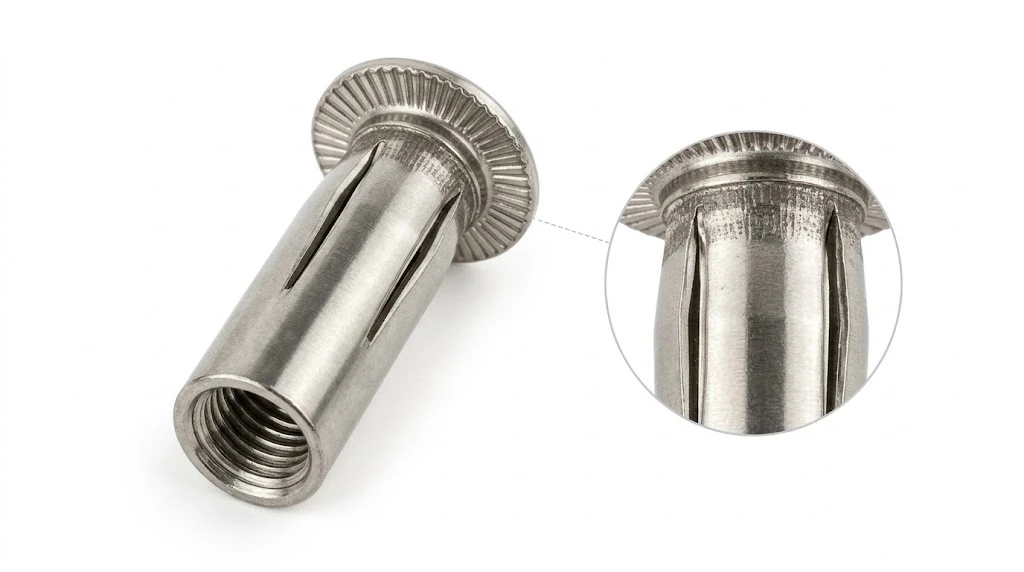
A plusnut is a blind rivet nut with lengthwise slots splitting the lower body into flexible parts. It fits in typical rivet nut tooling and accepts a machine screw because the flange and upper body have knurled or smooth shanks, internal machine threads, and flat seating flanges.
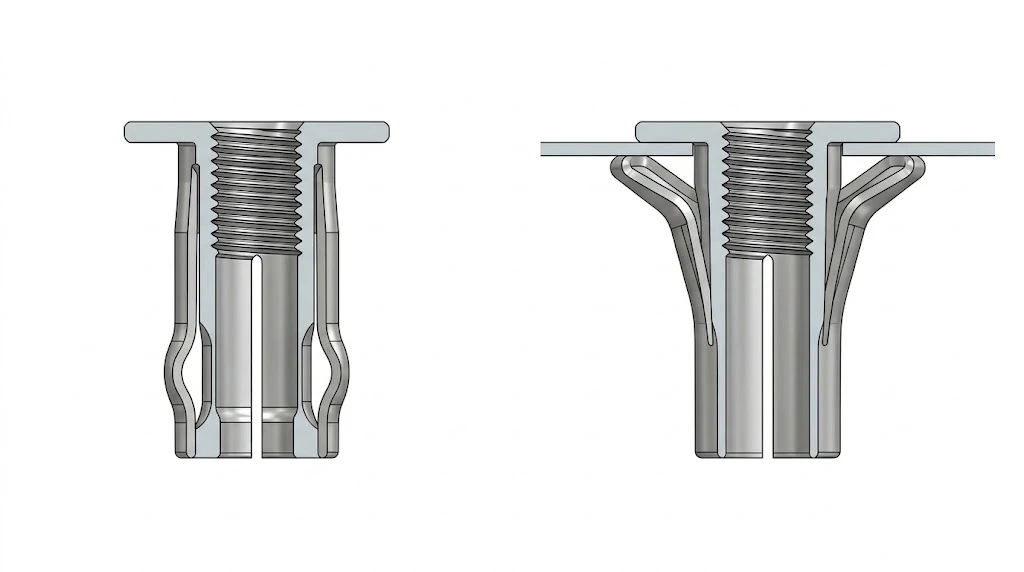
Installation varies. Traditional rivet nuts must be crushed to bulge against the sheet's back. Setting simply compresses the bulged body, bringing the slotted segments inward and upward to gently clamp the back face. The sheet receives a fraction of the radial load of a rivet nut during installation.
The part's name appears on every drawing we quote because of its internal geometry: the category's pre-bulbed, slotted body.
Why "Pre-Bulbed" Changes Everything
Consider what the host sheet is asked to do during a normal rivet nut set: resist several kilonewtons of outward pressure concentrated in a small annular zone. In 2 mm aluminum, fine. In 0.8 mm sheet, in magnesium, in glass-filled nylon, in a painted or powder-coated surface - that pressure leaves marks, distortion, or worse, a cracked panel discovered at final assembly.
A pre-bulbed slotted body reverses the force direction. The segments collapse toward the shank as they set, so the dominant loads on the sheet are axial: flange clamping in front, segment contact behind. The consequences in practice:
- No dimpling on thin-gauge aluminum and steel, even below 1 mm.
- No cracking in brittle host materials - composites, castings, rigid plastics.
- Coatings survive. Paint and anodizing on the back face are not subjected to expanding pressure, which matters enormously for corrosion performance.
- Predictable set height, because the deformed geometry is designed in, not improvised by the operator's trigger pull.
The Slotted Body: How Four Legs Do the Work
The slots divide the pre-bulbed lower body into segments - typically four - each behaving like a small cantilever leg. During setting, the pull-up force draws the slotted section against a flat anvil or the sheet itself; the legs fold at their designed hinge points until the gaps close and the flange seats.
Two engineering details decide performance:
- Segment length versus grip range. Longer segments span thicker stacks and produce more clamping travel; shorter segments set faster and stiffen the joint. Parts are therefore specified by grip range, and choosing the narrowest range that covers your stack-up gives the strongest result.
- Hinge geometry. The slots stop at a defined point so the segments fold cleanly rather than tearing. Slot width, depth and tip profile are die-controlled features - precisely the kind of tight-tolerance geometry our CNC and precision forming equipment is built to hold consistently, batch after batch.
Once set, the folded segments create a wide, multi-point footprint behind the sheet. Pull-out load is carried by four legs instead of one continuous bulb, and rotation resistance comes from the flange knurl plus the segment contact - no separate torque band required.
Applications Where It Earns Its Place
The spec sheet reads as a list of materials that punish ordinary rivet nuts:
- Thin-gauge sheet metal - electronics enclosures, brackets, heat sinks and EMI shields below 1.5 mm.
- Automotive body and trim panels, where rear-face coatings must remain intact and panel distortion is a warranty issue.
- Appliance and HVAC assemblies in painted or galvanized sheet.
- Composites and rigid plastics in robotics, medical device housings and outdoor equipment - markets where our customers already trust machined KEY-CNC components.
Any thread placed in these materials is usually for the life of the product, assembled and serviced repeatedly. The folded segments keep the clamp stable through those cycles, which is the quiet reason engineering teams standardize on it once they have tested it.
Hot Tags: plusnut: pre-bulbed slotted body rivet nut, China plusnut: pre-bulbed slotted body rivet nut manufacturers, suppliers, factory