

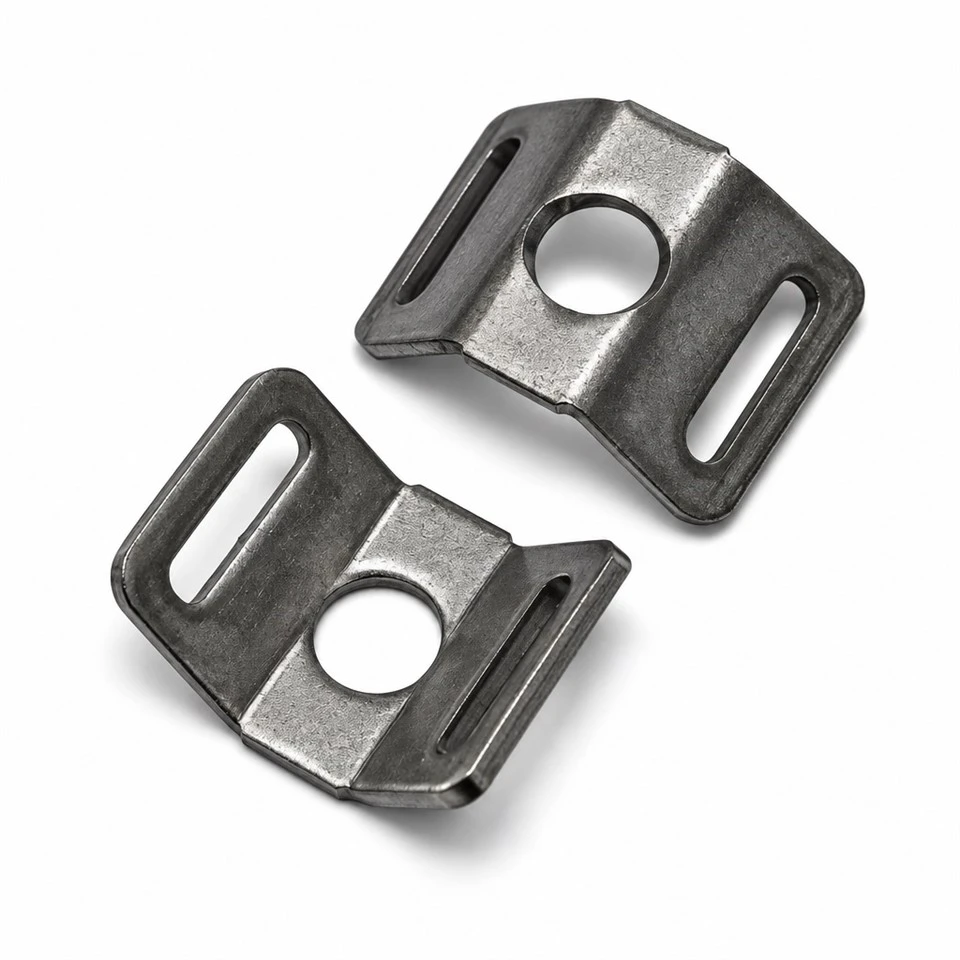
P-clips, cable clamps, and cable tacks contact the cable directly, so their size must match the bundle diameter. A saddle mount works differently. It secures the cable tie to the panel without touching the cable insulation.
This makes selection more straightforward. The key factors are tie width, slot size, mounting-hole dimensions, panel thickness, and operating environment-not cable diameter or jacket hardness.
One mount can therefore accommodate different cable bundles, provided the tie fits the slots and the assembly meets the application requirements. For panel builders, this simplifies inventory and allows mounting points to be installed before wiring begins, even when cable sizes change later.
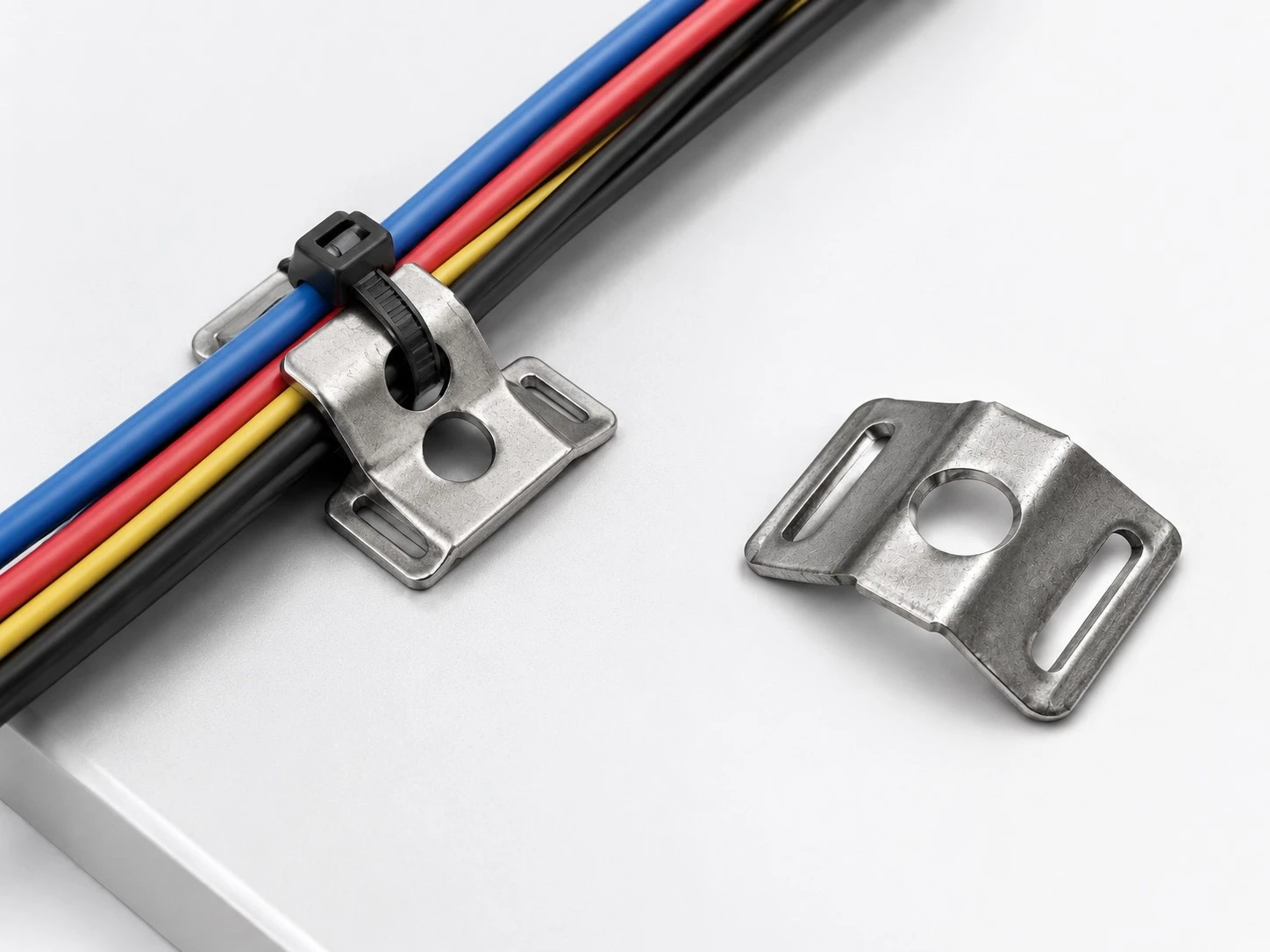
Reading the Stamp: Slots, Bridge, Hole and Ear
Each feature controls band clearance, fastener fit or load distribution.
The Slot: Band Clearance
An elongated slot lets the band pass through without sharp bends that concentrate stress or damage coatings. Typical slot lengths are 8–16 mm, with 0.3–0.5 mm clearance per side. Excessive clearance allows movement; insufficient clearance makes installation difficult.
The Bridge: Working Clearance
The raised bridge clears the band and, where necessary, the fastener head. A typical height is 2–6 mm. Too little clearance causes rubbing; too much increases bending loads on the ears.
The Centre Hole: Fastener Fit
The centre hole may provide clearance for M4–M8 fasteners or be tapped for direct mounting. Typical clearance diameters are 5.3 mm for M5, 6.6 mm for M6 and 9 mm for M8. Deburring both faces helps the mount sit flat. An elongated centre hole can accommodate panel misalignment.
Torque, Rotation, and Common Installation Failures
|
Common Failure |
Cause |
Recommended Solution |
|---|---|---|
|
Crushed bridge |
Excessive tightening deforms the bridge, allowing the band to rub against the panel. |
Specify appropriate tightening torque and consider a flange-head screw. |
|
Mount rotation |
A single fastener allows movement under vibration or angled band tension. |
Add a second fixing hole, anti-rotation tab or knurled underside. |
|
Band contacts screw head |
Insufficient bridge clearance causes rubbing and wear. |
Use a low-profile screw, a matching countersunk fixing or a taller bridge. |
|
Incorrect band width |
A narrow band shifts within the slot and wears against its edges. |
Specify compatible band widths on the drawing. |
|
Protruding band tail |
An unfinished tail can damage nearby cables or injure installers. |
Flush-cut and deburr the band tail after tightening. |
Our factory


Hot Tags: stainless steel cable tie saddle mounts, China stainless steel cable tie saddle mounts manufacturers, suppliers, factory


