Tension Tuning Tool Reach-Free
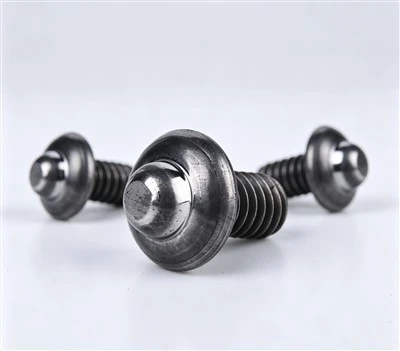
The slotted capstan screw was developed for tight bays like metre housings, RF shield cavities and sub-panel connectors where a screwdriver may not fit or the user cannot hold a knob. The head's cross-holes turn a small wire or nail into a micro-lever, so tension can be tightened or loosened in controlled increments rather than 90-degree jumps with each quarter-turn. These fasteners are used as standard in seal-wire applications, in lead-sealing closures and enclosures needing a calibrated hold-down force without over-torquing.
If blade access is possible from above, the slotted drive channel offers an alternative way, eliminating the need for a pin or wire. Two access problems solved simultaneously by dual-drive geometry saves maintenance inventory SKUs and streamlines field-service documentation. For servicing remote enclosures or instrument panels in tight cabinets, technicians can drive the same fastener with a flat-blade screwdriver, safety wire or paper clip.
Incremental tuning is very significant in precision equipment . A container secured with standard hex bolts. Roughly torqued using tight or loose steps, no tactile input. In contrast, the cross-hole lever allows the user to progressively feel the difference in resistance as each short turn adds preload. This micro adjustment allows for minimising gasket over-compression and substrate deformation in calibration laboratories and sealed-reference enclosures, extending equipment accuracy and seal longevity.

Head Geometry, Dual Drives
Slotted capstan screws are low profile cylinders having two or four through holes symmetrically around the diameter, and a transverse slot centred on the top face. This head is turned by Key-CNC in a single configuration to micron-accuracy between head body, cross-hole axis, and thread pitch diameter. DIN 404 schedules for slot width and depth prevent cam-out of standard flat blade drivers under moderate hand torque.

Radial symmetry is necessary: if cross-holes are moved even 0.05 mm, then the advantage of the wire-lever becomes unequal and the operator perceives inconsistency of clockwise and anticlockwise resistance. Key-CNC drills and reams all the cross-holes as the head rotates, locking positional precision in place before the workpiece exits the spindle. Milling the slot immediately, without re-fixturing, provides a common reference datum for the slot centerline, cross-hole axis, and thread helix. This total approach is what differentiates precision-machined parts from commodity stampings.
Key dimensional parameters (DIN 404 reference):
|
Parameter |
M3 |
M4 |
M5 |
M6 |
|
Head dia. D (mm) |
5.5 |
7.0 |
8.5 |
10.0 |
|
Head height H (mm) |
1.5 |
2.0 |
2.5 |
3.0 |
|
Slot width N (mm) |
0.8 |
1.0 |
1.2 |
1.6 |
|
Cross-hole dia. (mm) |
2.2 |
3.0 |
3.8 |
4.5 |
|
Min. thread length P (mm) |
1.0 |
1.4 |
1.7 |
2.2 |
Each order is reviewed by the Key-CNC engineering department for DFM compliance before manufacturing starts. Larger wire passageways, non-standard pitches and body lengths up to 300 mm without tooling changes can be handled by the same CNC turning procedure.
CNC Turning, Thread Integrity
Each Key-CNC slotted capstan screw is CNC turned, not stamped or cold-headed. CNC lathe single-point thread cutting creates pitch diameters and lead angles with 6H/2B class tolerances for critical-meter and instrumentation assemblies where thread play affects measurement accuracy. To ensure radial symmetry within ±0.05 mm, cross-hole locations are concurrently drilled and reamed.
Every lot is regulated by ISO 9001:2015, from incoming material verification to real-time spindle-speed and feed-rate monitoring to CMM dimensional validation of head diameter and thread geometry to optical slot and hole profile comparison before shipment Documented tracking from raw stock to final part is available upon request. The repeat-order rate exceeding 95% for Key-CNC's 1,200 unique product variations to over 1,000 global clients shows process reliability, not luck.
Following turning and hole drilling, deburring is needed. Cross-hole burrs restrict wire insertion and seize safety wire during field adjustment; slot entrance burrs affect blade engagement and driver wear. To ensure smooth operation from the first installation, Key-CNC deburrs cross-holes, slot exits, edge chamfers, and radius breaks The head face typically has a surface roughness of Ra 0.8 μm, with Ra 0.4 μm accessible for tactile and visual clarity in optical and medical devices.
Selection Guide: Access, Retention & Environment
|
Decision Factor |
Recommendation |
Rationale |
|
Overhead tool access blocked |
Cross-hole drive only |
Wire/pin lever provides fine incremental torque without vertical clearance |
|
Mixed-access maintenance crew |
Slotted + cross-hole (standard dual-drive) |
Either method works; no special tools to stock |
|
Field-serviced enclosures (anti-loss) |
Captive variant + threaded washer |
Fastener stays in panel; no dropped hardware during on-site repairs |
|
Salt-spray / marine exposure |
316 stainless steel, passivated |
Chloride resistance per ASTM A967; cross-holes drain, no moisture trap |
|
Light-weight UAV or portable gear |
6061-T6 aluminum, anodized |
Density 1/3 of steel; Type II/III anodizing adds wear resistance |
|
Seal-wire / lead-sealing closures |
Brass C36000, plain finish |
Electrical conductivity for tamper-indicating circuits; easy visual inspection |
Every Key-CNC quotation includes a DFM study that matches your material and configuration to your application's load, vibration, and corrosion profile before cutting the first chip to ensure component performance. For designs that must survive salt fog, heat cycling, or multiple assembly-disassembly cycles, the engineering team detects issues early. High-vibration brass bodies and marine aluminium heads may need thread-locking patches. Not cosmetic Type III hard anodising Type II. These suggestions are based on 16 years of CNC machining.
Surface Finishing Integration
After turning the head body, the cross-holes and slot are machined, so surface-finish timing counts. Type II ornamental or Type III hard-coat anodising should be ordered after all mechanical features are cut to avoid oxide layer interference with slot engagement or wire passage. Passivation per ASTM A967 removes free iron from machined surfaces without changing dimensions, preserving slot fit and cross-hole clearance for stainless-steel bodies. Indoor equipment has mild corrosion resistance from black oxide on carbon-steel, while outside metre enclosures exposed to humidity and condensation have stronger, more uniform electroless nickel plating.
Key-CNC's one-stop service concept schedules turning, thread cutting, cross-hole drilling, slot milling, deburring, and finishing under one production order. No vendor handoffs or process dimensional drift. The part comes at your plant ready for installation with every surface-head, slot, cross-hole, thread, shank-matching the drawing callouts.
From Prototype to Volume: Key-CNC Delivery
Whether you need 50 pieces for a prototype meter housing or 200,000 units for a production run of industrial enclosures, Key-CNC scales without re-qualifying the process. Prototype orders ship in 5–7 working days; volume production completes in 12–18 working days. Every shipment carries inspection records, material certificates, and a first-article report confirming that thread dimensions, cross-hole geometry, and slot profile meet your drawing requirements.
Custom options include non-standard lengths (up to 300 mm), fine-pitch threads, high-temperature nylon locking patches, and captive-washer combinations. OEM packaging with barcode-labeled bags or compartmented trays is available for production-line integration. For clients managing global supply chains, Key-CNC's multilingual support team and English-speaking engineers streamline communication from quotation through delivery, reducing misinterpretation risk on critical specifications like thread class, surface callout, and cross-hole tolerance.
Hot Tags: slotted capstan screw, China slotted capstan screw manufacturers, suppliers, factory