

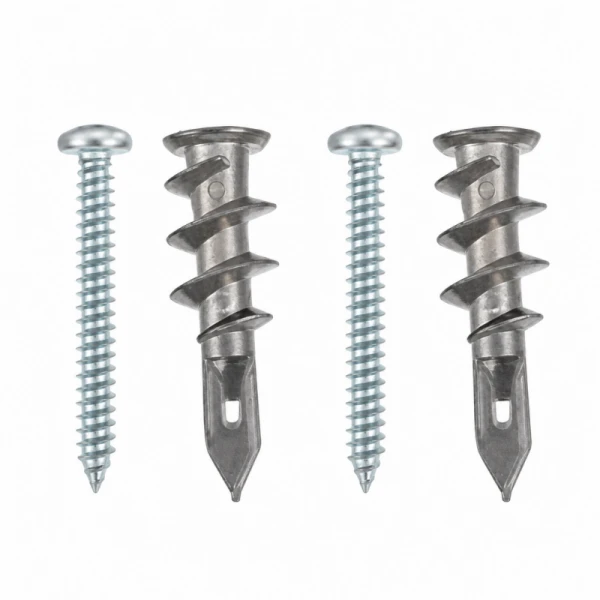
What Is a Self-Drilling Plasterboard Anchor?
A self-drilling plasterboard anchor is a zinc-alloy or plated steel fixing that threads directly into drywall without a pilot hole. The body carries a coarse external thread that is sharp enough to cut into 9–15 mm gypsum board, while the internal thread accepts a machine screw - usually M4 or a #8–#10 equivalent. The flange seats flat against the wall surface and stops the anchor from pulling through.
The key word is self-drilling. Conventional wall plugs need a drilled hole sized exactly right; too large and the plug spins, too small and the plug cracks the board. This self-tapping fixing skips that step entirely. It is driven in with a Phillips or square-drive bit, cuts its own path through the paper face and gypsum core, and leaves a reinforced metal thread behind - one that can be loaded, unloaded and reloaded without tearing the wall.
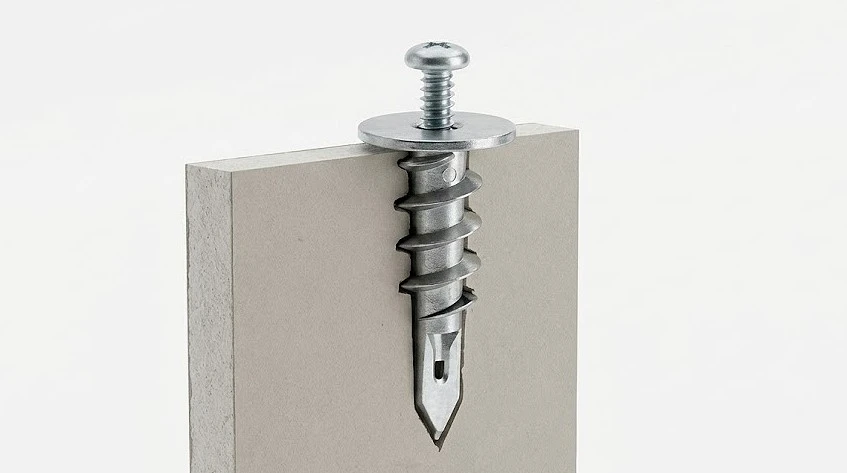
How the Helical Body Does the Work
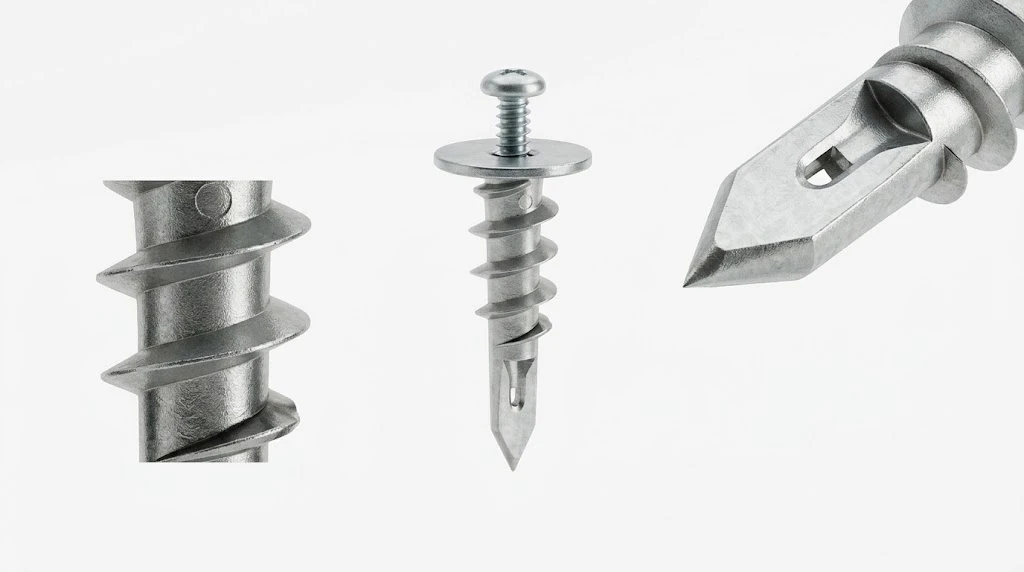
The external thread is not a standard machine thread. It is a wide, deep, sharp-crested helix - closer to a wood screw's aggressive pitch than to a bolt thread - and every detail exists for a reason:
- Deep flanks bite into the gypsum core over a large contact area, so pull-out force is spread across the whole embedded length instead of concentrated at one weak layer.
- A cutting notch near the tip starts the thread and prevents the board's paper face from tearing as the anchor advances.
- Anti-rotation geometry below the flange resists spin-out once the anchor is seated, which is what actually ruins most plasterboard fixings.
- A slotted tip region helps the body clear gypsum dust rather than compacting it, keeping driving torque predictable.
Because the anchor displaces and compresses the core rather than removing it, the board material around the thread is densified - a small but real gain in holding power that a drilled hole can never offer.
Why the Matching Screw Matters
The image most buyers miss: the anchor is only half of the product. The machine screw that goes into it defines the joint. A matched pair means the screw's thread class, length and head geometry are chosen against the anchor's internal thread and the thickness of the item being fixed.
Too short a screw leaves the anchor's internal thread partly unloaded; too long bottoms out and spins uselessly. A pan-head or countersunk screw must also be matched to the flange so clamp load lands on the anchor - not on the plasterboard edge. Supplying anchor and screw together, sized as one assembly, removes the most common cause of field failure: a fastener pair that was never designed to meet.
Load Behaviour in Gypsum Board
Honest numbers matter more than marketing ones. In standard 12.5 mm plasterboard, a single self-drilling plasterboard anchor typically provides a safe working load in the range of 15–25 kg depending on board density, wall orientation and the direction of load. Pull-out (direct tension) is usually the stronger mode; rotational and edge-distance failures set the real limits.
Practical rules that follow from the geometry:
- Keep anchors at least 60 mm from board edges and cut-outs, where the core is weakest.
- Shear loads - shelf brackets, cabinet rails - perform best when the screw shank, not the board, carries the weight close to the flange.
- For multiple points, distribute the load; never assume one anchor can carry what four share comfortably.
These are the conversations our engineering team has with customers daily, because the anchor is cheap - the wall damage from a wrong assumption is not.
Sizes, Materials and Surface Treatment
Standard sizes cover M4 internal thread with body lengths suited to 9–15 mm board. Beyond the catalogue, KEY-CNC produces self-drilling plasterboard anchors to customer drawings: alternative internal threads, custom body lengths for double-layer board, and material changes for special environments.
- Carbon steel, zinc-plated - the standard for interior drywall; economical and fully adequate for indoor humidity.
- Zinc alloy bodies - sharp, clean thread-forming from a die-cast or machined blank, with excellent surface finish.
- Stainless options on request - for damp interiors, leisure vehicles and marine cabin linings where ordinary plating eventually stains.
Surface treatment follows our standard sheet: zinc plating with trivalent chromium passivation for RoHS compliance, with other finishes available per drawing. Every batch is verified with salt spray testing and coating thickness measurement before shipment.
Standard sizes cover M4 internal thread with body lengths suited to 9–15 mm board. Beyond the catalogue, KEY-CNC produces self-drilling plasterboard anchors to customer drawings: alternative internal threads, custom body lengths for double-layer board, and material changes for special environments.
Hot Tags: self-drilling plasterboard anchor with matching screw, China self-drilling plasterboard anchor with matching screw manufacturers, suppliers, factory


