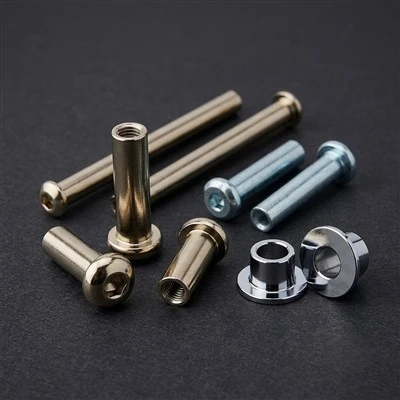
Metal Round Tube Inserts Threaded Handle Screw Nut integrates a tube end finish, ergonomic grip handle, and threaded mounting function into one compact component for round tube applications. Designed for secure installation and clean appearance, KEY-CNC manufactures custom metal round tube inserts through CNC turning and precision forming processes, achieving tight tolerances of ±0.02-0.05mm. The integrated threaded handle screw nut design provides reliable fastening and easy assembly for furniture, equipment, and industrial structures. Learn more about our tube end finish solutions and CNC turning capabilities.


An open round tube end creates three common challenges: exposed edges can cause burr hazards and allow debris or moisture entry; the bare tube provides no ergonomic grip point; and there is no threaded anchor available for mounting accessories or connecting structures.
Traditional solutions require separate components, such as tube plugs, external handles, and welded or pressed threaded nuts. This increases sourcing complexity, assembly steps, and potential failure points caused by loosening, vibration, or corrosion at connection interfaces.
A metal round tube insert with threaded handle screw nut combines these functions into one integrated component. Installed inside the tube, the insert provides a finished tube end, a secure grip surface, and a built-in threaded anchor for mounting. The press-fit or thread-lock design ensures reliable installation while reducing components, assembly time, and interface gaps.
Unlike panel-mounted fasteners, round tube inserts rely on the fit between the tube's inner diameter (ID) and the insert's outer diameter (OD). Proper ID tolerance control is critical for achieving reliable retention and preventing looseness or deformation.
Tight-tolerance tubes are suitable for press-fit inserts, while tubes with wider ID variation may require knurling features or a thread-lock design to provide stable engagement. Wall thickness also determines the suitable locking method. Thicker tube walls can withstand press-fit deformation, while thin-wall tubes typically require thread-lock or elastic locking features to avoid tube damage.
Key-CNC performs DFM review based on tube material, ID range, wall thickness, and application requirements to determine the appropriate insert structure and tolerance design.

Tube-End Applications - Where Round Tube Inserts Replace Three Separate Parts

Furniture Tube Feet and Table Leg Ends
Round tube furniture requires tube ends to be sealed, leveled, and adjustable. Traditional solutions use separate plugs, leveling feet, and pads, increasing components and potential interface gaps. A metal round tube insert combines sealing, leveling thread connection, and grip function in one component.
Medical Cart and Stretcher Grip Rails
Medical equipment rails require sealed tube ends, durable grips, and secure mounting under repeated cleaning and impact. A stainless steel round tube insert replaces separate caps, grips, and welded mounts with one integrated component for reliable connection and easy maintenance.


Fitness Equipment Adjustment Handles
Fitness equipment adjustment points require secure grip, tube protection, and stable thread locking under repeated loads. A metal insert integrates a sealed tube end, knurled handle grip surface, and locking thread for tool-free adjustment.
Industrial Railing and Handrail End Caps
Railings and handrails need sealed ends, safe grip surfaces, and reliable mounting connections. A round tube insert provides a finished tube end, handle grip function, and threaded mounting interface without welding.

Tube Material - Insert Material Compatibility Chart
When a metal insert engages a metal tube bore, two material selection considerations dominate that do not apply to panel-mounted fasteners: galvanic corrosion risk at the tube-insert contact surface, and thermal expansion mismatch that can loosen an interference fit under temperature cycling.
| Tube Material | Recommended Insert Material | Compatibility Reason | Material to Avoid |
|---|---|---|---|
| Carbon steel tube | Carbon steel insert / Zinc-plated steel | Same base metal - no galvanic potential difference; zinc plating adds corrosion protection at exposed surfaces | Brass (copper-steel creates an active galvanic cell; brass corrodes sacrificially in wet environments) |
| Aluminum tube (6061-T6) | Stainless steel 304 insert | Stainless steel is harder than aluminum for press-fit engagement; passivation layer electrically isolates the contact surface, preventing galvanic current flow | Unplated carbon steel (steel-to-aluminum galvanic pair in moist conditions; steel corrodes rapidly at the tube bore contact point) |
| Stainless steel tube (304 / 316) | Stainless steel insert (matching grade) | Same alloy series - thermal expansion coefficients matched (16–17 µm/m·°C for 304, 16 µm/m·°C for 316); no galvanic potential between same-series alloys | Aluminum insert (aluminum's lower hardness deforms under grip force in the stainless bore; 23 µm/m·°C expansion coefficient creates progressive loosening across thermal cycles) |
| Brass tube | Brass insert / Nickel-plated steel | Brass-to-brass contact is galvanic-neutral (both copper-base alloys); nickel plating on steel inserts creates a non-reactive barrier layer | Bare steel in brass (steel-to-copper galvanic pair; steel corrodes at the contact surface in any humid environment) |
Surface treatment selection follows the compatibility chart: zinc plating for carbon steel pairs, passivation for stainless-to-stainless and stainless-to-aluminum pairs, nickel plating for steel-in-brass configurations, and anodizing for aluminum insert bodies in any tube material.
Metal Round Tube Inserts Threaded Handle Screw Nut Specifications
| Parameter | Options | Engineering Note |
|---|---|---|
| Tube ID range (mm) | 16–50 (standard range); custom sizes available beyond | Cross-reference against DIN 2391, ASTM A513, and JIS G3445 tube specifications for tolerance matching |
| Thread type (internal) | Metric M4–M12; UNC #8–½" | Internal thread provides the mount-to-base connection - thread engagement length should be ≥1.0× nominal diameter for load-bearing applications |
| Thread type (external) | Metric M6–M16; optional specification | External thread provides accessory attachment on the handle end or thread-lock engagement in thin-wall tubes |
| Handle OD (mm) | 25–40 (full-hand power grip); 12–18 (finger-tip precision grip) | Per ISO 9241-9 ergonomic reference - handle diameter determines maximum sustainable grip force |
| Grip surface | Smooth / Straight knurl / Diamond knurl / Fluted (grooved) | Knurl adds +0.3 friction coefficient; fluted adds +0.15; smooth baseline is 0.2 |
| Wall thickness engagement | ≥0.8mm → press-fit; <0.8mm → thread-lock or elastic clip | Design strategy shifts at the 0.8mm threshold - press-fit requires sufficient host material thickness to absorb radial deformation |
| Surface treatment | Zinc plating / Passivation / Anodizing / Black oxide / Nickel plating | Selected per tube–insert material compatibility chart above |
| Manufacturing tolerance | Insert OD ±0.02mm; internal thread 6H; external thread 6g | Key-CNC CNC turning and thread machining standard precision level |
| Production range | Prototype verification → Small batch → Volume manufacturing | Lead time 10–15 working days for standard orders; expedited 7-day available for prototype quantities |
Frequently Asked Questions
How do I specify the right tube ID for my round tube insert?
+
-
Provide your tube's inner diameter (ID) and wall thickness. KEY-CNC cross-references this against standard tube specs (DIN 2391, ASTM A513) and recommends the insert OD with the correct press-fit or thread-lock approach. A tube sample or cross-section photo helps us verify within 24 hours.
Can one insert work for both steel and aluminum tubes?
+
-
Not with the same OD. Steel and aluminum tubes have different ID tolerances and wall thickness ranges. The insert's locking mechanism also changes-press-fit works in aluminum (softer host material), while steel tubes often require a thread-lock design. We design per your specific tube material.
What grip force can a threaded handle insert withstand before the tube slips?
-
For a standard M8 internal thread in a 1.5mm wall steel tube, the grip-to-slip threshold is approximately 150N axial load. This increases with knurled grip surfaces (+30%) and decreases in thin-wall or aluminum tubes. We calculate the specific threshold during DFM review.
Do round tube inserts require special installation tools?
+
-
Press-fit inserts slide in by hand or with a light press. Thread-lock inserts require a wrench or hex key for the final tightening step. No welding, no adhesives, no secondary hardware-installation completes in one action from one side of the tube.
Hot Tags: metal round tube inserts threaded handle screw nut, China metal round tube inserts threaded handle screw nut manufacturers, suppliers, factory