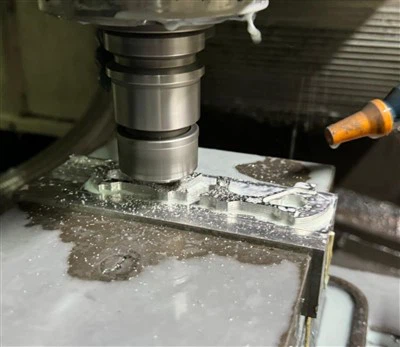
Why Medical Components Need Different Machining
Despite using 316L stainless steel, a surgical instrument handle and a consumer electronics bracket have quite different technical standards. The medical portion must withstand hundreds of autoclave cycles at 134°C, resist bacterial adhesion, and preserve crucial dimensions. Thus, medical component precision CNC machining begins with design verification, where CAD/CAM models are compared to the part's functional environment, sterilisation process, and assembly interface.
Medical machining differs from manufacturing in three ways:
Tighter tolerance allocation for clinically important features including trocar guide holes, valve seat bores, and instrument jaw alignment surfaces.
Material traceability requirements that link raw-material certificates to production lots so that issues can be traced back via the manufacturing chain.
Surface integrity limits make cutting-parameter selection and post-process electropolishing equally crucial because even microscopic tool marks might become bacterial retention sites.

Pre-chip DFM Review: Engineering Issues
Key-CNC's application engineers perform a medical component-specific design-for-manufacturability (DFM) review before writing a programme. Thin-walled housing wall thickness ratios, deep-cavity tool-access clearances, and machining tolerance-downstream surface treatment interactions are examined in this paper.
When a stainless-steel surgical instrument is scheduled for passivation per ASTM A967, the DFM review verifies that hole diameters and thread pitches include sufficient pre-treatment allowance. Passivation removes a thin layer of surface iron, and without compensation, a dimensionally correct part can drift out of tolerance. To prevent hard-coat thickness from exceeding essential characteristics, Type III anodized aluminium components receive a predicted micron-level correction margin.
Allocating compensating margins before programming and machining rather than passively evaluating afterwards is key to precision CNC machining for medical components' consistent results across manufacturing batches.
Selecting Medical-Grade Machining Materials
Medical machining material selection is driven by end-use environment rather than cost. Key-CNC machines a clinically relevant array of medical-grade metals :
● Titanium (Grade 5 / Ti-6Al-4V ELI) is best for surgical instrument bodies and external device housings that require strength-to-weight ratio and corrosion resistance. Its limited thermal conductivity requires optimised feed rates and precise tools to prevent heat accumulation that could damage surface integrity.
● Precipitation hardening gives 17-4 PH the strength needed for high-load applications like orthopaedic drill guides, while stainless steel 316L is the standard for autoclave sterilisation. 440C is for edge-retaining cutting devices.
● Due to its light weight and thermal conductivity, medical equipment housings, imaging-system frames, and heat sinks use aluminium 6061-T6 and 7075-T6.

Surface Treatments for Clinics
Medical machining surface finish is useful, not ornamental. A sterilised surface that collects impurities or corrodes can ruin an instrument. Key-CNC selects three medical-compliant surface treatments during DFM based on part composition and clinical use:
Passivation (ASTM A967 / QQ-P-35) eliminates free iron from stainless-steel surfaces, creating a chromium-rich passive layer that improves corrosion resistance and lowers bacterial adhesion. This is standard for all facility-made stainless-steel surgical equipment.
Precision electropolishing levels small peaks to create a mirror-like surface that reduces contaminant retention and improves cleanability, essential for equipment that touch sterile tissue or biological fluids.
Type II and III anodising builds a robust, wear-resistant oxide coating on aluminium and titanium. Beyond durability, kind II anodising allows color-coding equipment by size or kind for easy visual identification in operating rooms, a tiny but important operational improvement for surgical teams.
Rapid prototyping to production validation
The development of medical gadgets is seldom linear. Design changes are needed in clinical trials, regulatory comments impact component shape and validation testing needs pilot quantities without full production tooling.
Key-CNC offers a no-MOQ technology for delivering operational medical prototypes in 7–10 days. Prototyping tools help engineers test shape, fit and function with genuine materials like PEEK, 316L and titanium, instead of surrogates which behave differently during sterilisation.
Once the design freeze is complete, the prototype engineering team manages volume production. Tool paths are repeatable, inspection plans are tied to prototyping CTQ parameters, material lots are tracked through production. This link from prototype to hundredth batch in manufacturing delivers precision CNC machining for medical components, preventing quality gaps that can appear if the prototype and production teams are working separately.
Component Categories We Routinely Machine
Key-CNC's medical machining experience spans four primary component categories, each with distinct engineering requirements:
Surgical instruments represent the most tolerance-sensitive category - scalpel handles, endoscope camera housings, orthopedic drill guides, trocar assemblies, micro-forceps, and hemostat clamps. These parts combine complex geometries with demanding surface-finish requirements and must maintain dimensional stability through hundreds of sterilization cycles.


Medical equipment hardware includes high-precision structural components for MRI and CT scanners, ventilator valve seats, ultrasound probe housings, optical instrument mounts, and fluid pump bodies. These parts prioritize long-term dimensional stability and material compatibility with imaging or fluid environments.
Laboratory and diagnostic components - blood analyzer manifold blocks, microfluidic chip molds, sampling needles, locating pins, chromatography assemblies - demand exceptional surface quality and tight bore tolerances to ensure analytical accuracy.


Dental tools and equipment, including handpiece shells, orthodontic instrument assemblies, and custom alignment fixtures, round out the component portfolio, combining precision machining with the ergonomic and aesthetic demands of dental practice environments.
Equipment and Machining Capabilities
The medical components described above are produced on a production floor equipped with CNC milling centers, CNC turning lathes, drilling and tapping centers, laser cutting machines, deburring stations, and ultrasonic cleaning equipment. This equipment mix enables milling, turning, drilling, stamping, and bending operations within a single facility - supporting the medical device industry's need for consolidated, traceable production rather than multi-vendor supply chains where quality accountability becomes diffused.
Inspection capabilities include CMM measurement, optical comparison, micrometers, and calipers, all operated under the ±0.03–0.05mm standard tolerance framework specified for general production, with tighter ±0.05mm precision tolerances applied to medical CTQ features. The ultrasonic cleaning step is particularly relevant for medical parts, as it removes machining residue from internal channels and blind holes that could otherwise contaminate sterile environments.
Hot Tags: precision cnc machining for medical components, China precision cnc machining for medical components manufacturers, suppliers, factory, CNC Machinable Materials and Processing Flow, CNC Machine Setups and Parts Orientation, cnc machining, CNC Machining Service for Industrial Applications, CNC Machining Services Apply To Parts Made Of Various Metals Materials, CNC Machining Services Precision Parts and Fast Turnaround