Routeing and Retention: One Tack, Two Jobs
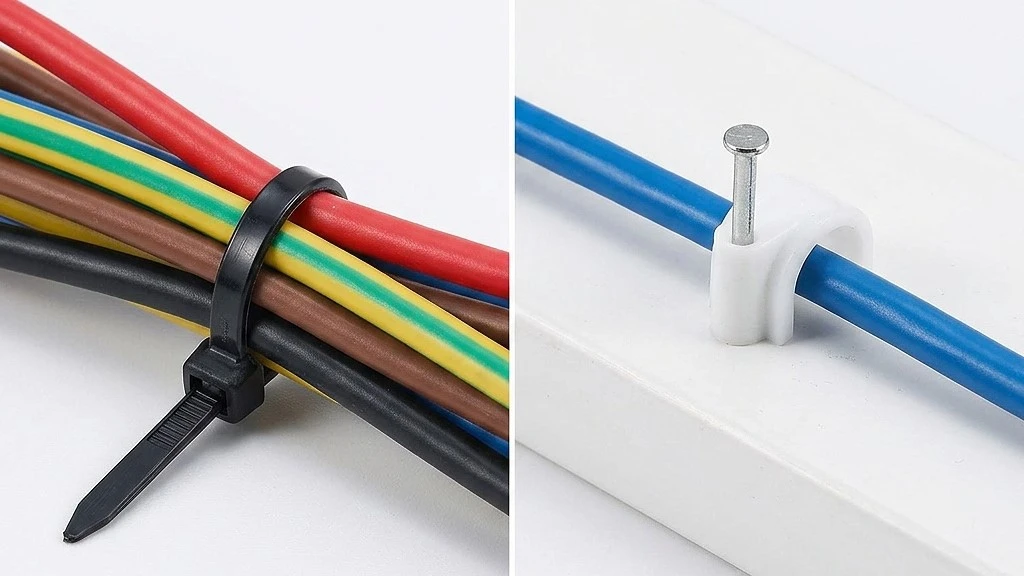
Two challenges: wire routeing/wire retention. Round cable tacks address both at once. Routeing is the process of laying the cable along a fixed path - around a corner, over a frame rail, into an enclosure - and the installers have no idea where the harness is routed. Retention is the defiance of the inevitable pull: the technician tugging the connector, the robot arm whipping by, the vehicle absorbing road impact.
A cable tie can achieve part of this, but it tightens. Overtightening one makes the jacket squeeze, the shielding distort, and the signal pairs change impedance. Instead, a tack is holding from outside: the cable is in the arc under its natural curvature, nothing is squeezing it and the jacket pressure is constant. That distinction matters in signal integrity applications or sealed jackets, which is why equipment makers specify unique cable tacks instead of defaulting to tie after tie.
Inside Loop: Arc, Legs, Lead-In
Three factors determine a cable tack's field performance:
- Arc radius. To seat the cable without slop or force, the loop is constructed to the cable's outside diameter plus 0.2-0.5 mm of clearance. Every harness has a different cable OD radius, therefore no arc size fits all.
- Coverage angle. An 180-degree arc holds a cable against a flat surface against gravity and springback. For vertical drops and moving assembly, arcs near 270 degrees retain sides.
- Lead-in and edge work. Before shipment, all edges are deburred and both arc ends have chamfered lead-ins to slide the jacket in without scoring. Sharp inner edges are the fastest way retention parts chafe.
Mounting surface determines leg design. Nail-in legs work with wood, plaster, and composite panels; screw-boss legs with sheet metal and machined plates; and broader pad legs with adhesive for bonded enclosures.

Holding force is adjustable. A somewhat open arc or release tab reduces insertion effort for assemblies technicians repair frequently. Wider arc coverage, a deeper draw, and a harder material increase grip against axial pull. Targets-50 N hold, one-hand removal-tell the shop which combination to machine, and the same drawing can show fixed anchors and servicing sites.
Materials, Finishes, and the Typical Envelope
Buyers sourcing round cable clips for OEM equipment quickly find that catalog parts rarely match the cable OD, panel thickness, and finish spec of a real design - which is where machining custom parts earns its place. The ranges below reflect the options KEY-CNC machines and forms in volume:
|
Feature |
Typical Range / Option |
|
Cable diameter held |
3-25 mm |
|
Arc coverage |
180°-270° |
|
Leg length |
8-30 mm |
|
Material |
304 / 316 stainless steel, 1045 carbon steel, spring steel |
|
Finish |
Zinc plating, black oxide, passivation |
|
Mounting style |
Nail-in, screw boss, adhesive pad |
|
Batch size |
Prototype runs through volume production |
Material choice follows the environment. Stainless steel is the default for medical devices, food-adjacent equipment, and anything facing washdown or salt - it needs no plating and will not rust onto the jacket. Zinc-plated carbon steel keeps costs down for indoor control cabinets and electronics enclosures. Spring steel adds snap: the arc flexes open during installation and closes behind the cable, holding without extra hardware.
Wire Coil to Bagged Part
The whole result is consistency. A tack that fits the cable on the first sample must fit the ten-thousandth in every later batch. Production sequence shows:
1. Forming. Wire-formed or stamped arcs and legs match the drawing's radius and leg geometry. Material certificates are available for each batch.
2. CNC-finish. Secondary features like screw bosses, mounting holes, chamfers, and specific profiles are machined after forming to maintain the arc.
3. Deburring. Deburring every lead-in and inner edge distinguishes cable protectors from destroyers.
4. Gauging. Before shipping, batch-by-batch, arc diameter and leg spacing are confirmed against cable OD.
Similar logic applies to packaging. Like all of KEY-CNC's bespoke output, brand printing, package format, colours, and materials can be selected, so tacks are kitted per work order rather than loose in a polybag. The same Shenzhen plant makes wire form parts, standoff spacers, and other bespoke fasteners that share a harness with cable tacks for automotive, medical, robotics, outdoor, electronics, and industrial automation industries. One vendor, matched quality, tighter schedules.
Hot Tags: round cable tacks, China round cable tacks manufacturers, suppliers, factory