How Metal Blind Rivets Work ?
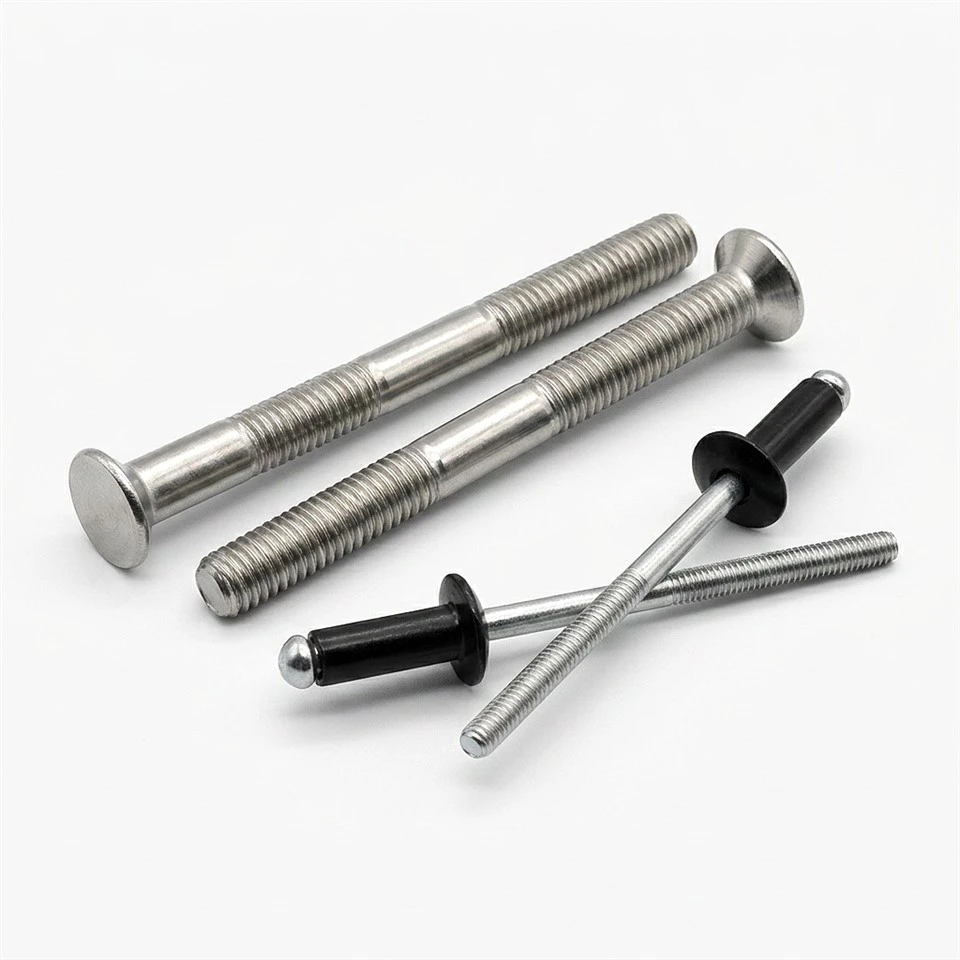
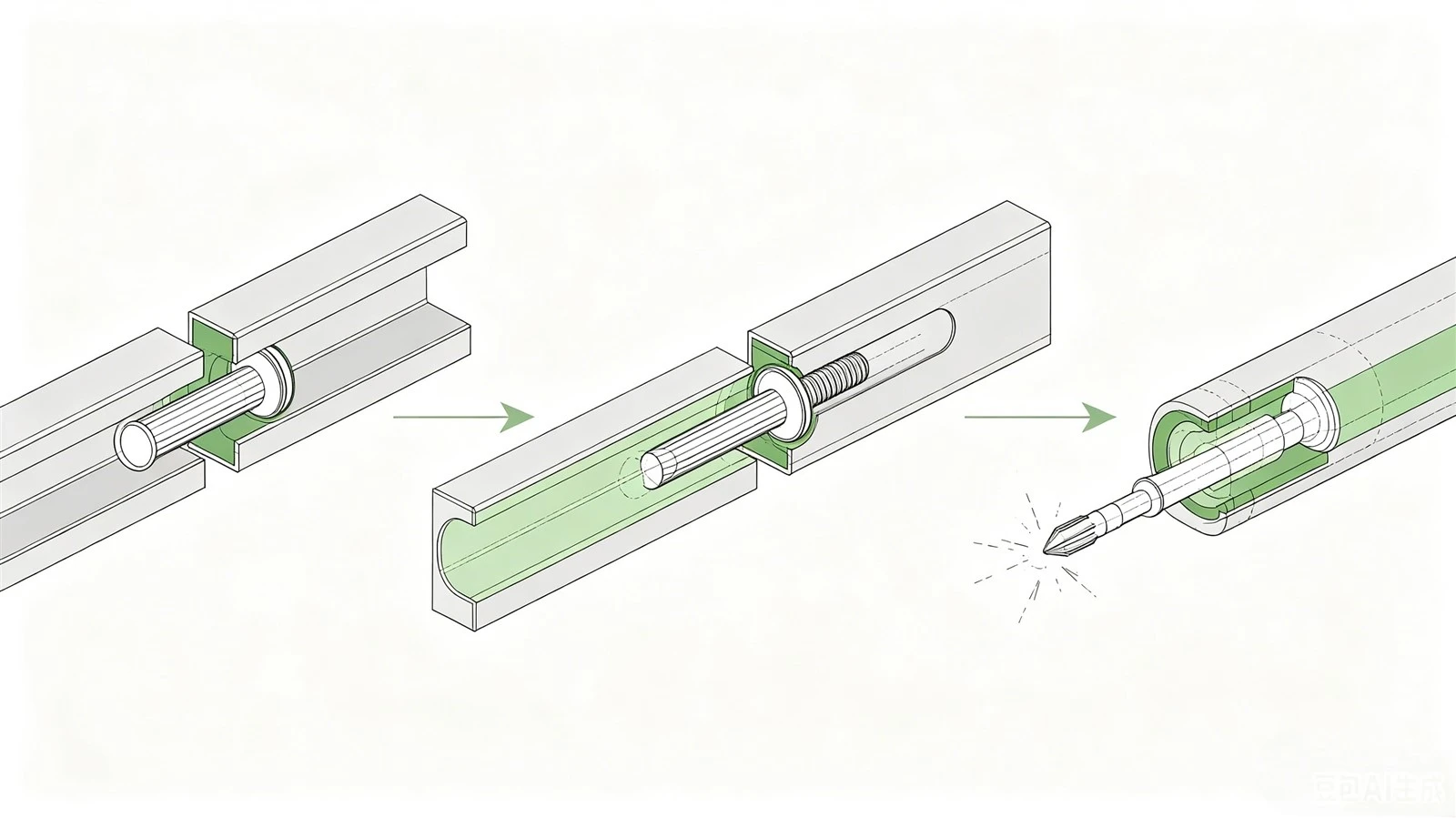
The blind rivet is made up of two parts, a hollow body and a mandrel that runs through the centre of that body. The rivet tool grabs the mandrel and pulls it during installation . The mandrel head stretches the blind side end of the body against the workpiece to clamp the layers of material together. At preset stress the mandrel neatly breaks at its engineered break notch leaving a flush completed head.
The key benefit is this one-sided operation. The panel does not need access from the rear and so the name "blind". The resultant joint gives a consistent clamp load, fills the hole firmly and resists loosening under vibration much better than threaded fasteners in thin-gauge materials. Pneumatic rivet tools can place one blind rivet every 1-2 seconds on high-volume production lines.
Material & Design Decisions
Selecting the right blind rivet involves four interrelated choices. Getting any one wrong can compromise joint integrity and field life.
Body & Mandrel Material Pairings
|
Body Material |
Mandrel Material |
Typical Application |
Key Advantage |
|
Aluminum 5052/5056 |
Steel (zinc-plated) |
General sheet metal, HVAC, signage |
Lightweight, cost-effective |
|
Aluminum 5056 |
Stainless Steel 304 |
Marine, outdoor enclosures |
Excellent salt-spray resistance |
|
Stainless 304/316 |
Stainless 304/316 |
Food equipment, chemical tanks |
Maximum corrosion resistance |
|
Carbon Steel |
Carbon Steel |
Structural steel, heavy machinery |
High shear & tensile strength |
|
Aluminum 5056 |
Aluminum 5056 |
Automation skin panels |
Eliminates galvanic corrosion |
Grip Length, Head Style
Head geometry affects load distribution and appearance.
Structural assemblies use dome head rivets because they clamp hardest. Countersunk heads flush with the panel face, important for sliding the assembly against adjacent components. Large flange heads spread the load to prevent pull through on soft or thin sheet materials.

Grip range-the rivet's maximum thickness must be within tolerance.
A rivet put below minimum grip will not expand adequately on the blind side. A value above the maximum will not clamp layers. Key-CNC provides rivets in grip increments from 1.6 mm (1/16″) to 25 mm (1″), including custom steps.

 Surface finish, corrosion resistance
Most rivets come with a basic or lightly oiled finish, but demanding applications require customised surface treatments. According to MIL-A-8625 Type II, aluminum-body rivets can be clear or coloured. Our CNC machining and this technique are done in-house. Passivated, zinc-plated, or zinc-nickel steel mandrels are available. Our engineering team recommends body–mandrel–finish combinations for assemblies that will be salt sprayed for 500+ hours during quoting.
Custom vs. Off-the-Shelf Rivets
Catalog rivets serve generic applications well. But when your assembly demands a non-standard diameter, a specific mandrel break load, a grip range between catalog steps, or traceability to a material heat lot, custom options become the only viable path. Key-CNC produces bespoke metal blind rivets from your drawing or sample, holding dimensional tolerances of ±0.05 mm on body diameter and ±0.1 mm on length. Every batch ships with a material certificate and inspection report, giving your quality team full documentation from day one.
Technical Specifications
|
Parameter |
Capability |
|
Body Diameter |
2.4 mm (3/32″) – 6.4 mm (1/4″); custom up to 9.5 mm (3/8″) |
|
Length Range |
4 mm – 50 mm; custom lengths available |
|
Body Materials |
Aluminum 5052, 5056, 6061; SS 304, 316; Carbon Steel; Brass |
|
Mandrel Materials |
Steel (zinc-plated), SS 304, Aluminum 5056 |
|
Head Styles |
Dome, Countersunk, Large Flange |
|
Plain, Anodized (Type II), Zinc Plated, Passivated, Black Oxide |
|
|
Dimensional Tolerance |
Body Ø: ±0.05 mm; Length: ±0.1 mm |
|
Production Method |
CNC turning + cold heading (volume-dependent) |
|
Quality System |
ISO 9001:2015; material certs & inspection reports included |
|
MOQ |
No minimum - prototype to production |
|
Lead Time |
Samples: 5–7 days; Production: 12–18 days |
Installation Tips
The correct installation is as important as the choice of rivets. Joints that are consistent and reliable: some guidelines.
Hole diameter must be larger than the rivet body diameter by 0.1 – 0.2 mm – tight for alignment, loose for insertion.
Match the rivet grip range to the whole thickness of the material stack. If layers are compressible (gaskets, foam, insulation), re-measure.
Use a calibrated pneumatic or battery operated rivet tool with the right nose piece. Manual hand tools are suitable for low volume operations but they add operator variability.
Test a small sample of structural joints initially. Check mandrel break load and blind side expansion as per your technical requirements.
When attaching different metals (e.g. aluminium rivets into a steel frame), assess the danger of galvanic corrosion and incorporate isolation devices such as nylon washers or sealant as necessary.
Blind Rivets vs. Hollow Rivets
A common question from procurement teams: what separates metal blind rivets from hollow rivets? The distinction affects both design and cost. Hollow rivets (also called semi-tubular rivets) require access to both sides of the workpiece - a press or hammer forms the clinch on the opposite side. Blind rivets, by contrast, install entirely from one side using a mandrel-pull tool. This makes them the only option for closed sections, pre-assembled modules, and field repairs.
Key-CNC manufactures both fastener types. If your application permits two-sided access and calls for high-volume, low-cost permanent joining, our CNC custom hollow rivets may be the better fit. If one-sided access is non-negotiable - which it often is in modern product design - metal blind rivets are your answer.
Hot Tags: metal blind rivets, China metal blind rivets manufacturers, suppliers, factory