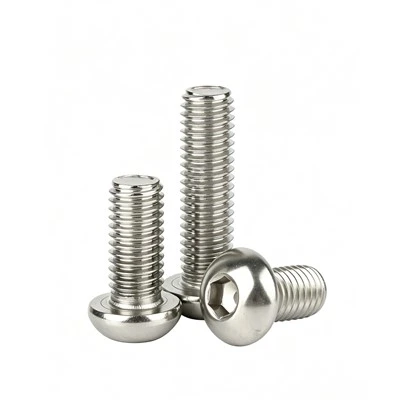
Most binding posts use flat or pan heads that sit above the surface. A countersunk head and matching hole allow the fastener to sit flush with the panel, preventing snags on webbing, upholstery, or routed cables.
The 90° cone also improves alignment during assembly by centering the screw in the hole. More than an aesthetic feature, countersinking distributes head load across a wider contact area, providing better support than a small pan head on the same thread.
However, the cone removes material from the head, creating a balance between flush installation and head strength. Understanding this trade-off is essential when selecting the right countersunk fastener.

The Thin-Head Problem - Socket Depth vs. Cone Depth
A countersunk head has limited space for both the hex socket and cone structure. If the socket is too deep, the remaining wall thickness can weaken the head and affect torque performance.
During DFM, we balance socket depth, head diameter, and countersink geometry to maintain strength. When higher torque is required, increasing head diameter is often more effective than deepening the socket.
Torque Rules for Countersunk Socket Heads
Hex sockets provide strong torque transfer with minimal cam-out, but countersunk heads are usually limited by head strength rather than drive performance.
Use the recommended thread torque and ensure full hex key engagement. For vibration-prone applications, threadlocker or other anti-loosening solutions can improve joint reliability.

Countersink Preparation and Assembly Sequence
Match the countersink angle to the head
The countersink angle must match the screw head to ensure full contact and a true flush fit. A mismatched angle can cause the head to sit high or low, reducing load distribution. Always verify the countersink angle and finished diameter against the actual fastener dimensions.
Pilot hole, seating, and reassembly
Drill the through hole for free shank clearance and countersink both faces when a flush finish is required on both sides. Tighten until the cone seats fully, avoiding over-torquing that can stress the thin head section. With proper sizing and full hex key engagement, a quality binding post can withstand repeated assembly cycles.
Frequently Asked Questions
How do I choose the correct barrel length for a countersunk joint?
+
-
Select the barrel length based on the total assembled panel thickness and required thread engagement. Since the head sits below the surface, calculate using the actual countersunk panel thickness rather than the original sheet thickness.
Can a countersunk head handle the same torque as a pan head?
+
-
Countersunk heads generally have less material around the drive area because of the cone design. If higher torque is required, consider increasing the head diameter or adjusting the fastener design instead of simply deepening the socket.
Will the hex socket wear out after repeated assembly?
+
-
With a properly sized hex key and full socket engagement, countersunk Chicago screws can withstand repeated assembly cycles. Socket life depends on material, tool condition, and correct installation practices.
Can both sides of the joint be countersunk for a fully flush finish?
+
-
Yes. We can machine countersunk features on both the male screw and barrel end, allowing the assembled binding post to sit flush on both sides of the panel.
Do you supply the male screw and barrel as a matched set?
+
-
Yes. Our Chicago screws and binding posts are manufactured as matched pairs to ensure smooth threading, consistent fit, and reliable assembly performance.
Hot Tags: hex socket countersunk chicago screw, China hex socket countersunk chicago screw manufacturers, suppliers, factory