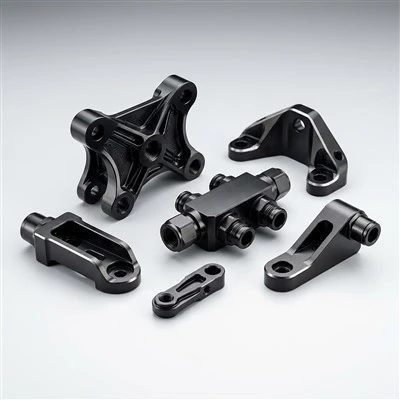
Decorative anodizing is an electrochemical process that converts the surface of aluminum into a controlled oxide layer.
Unlike paint or coating layers, this oxide structure grows from the base metal itself, creating a surface that is fully integrated rather than applied externally.
This structure allows pigments to be absorbed into microscopic pores, producing stable color finishes that are resistant to peeling, cracking, or delamination.
In practical terms, decorative anodizing combines two functions in one process:
- Visual enhancement through controlled coloring
- Functional protection against corrosion and wear
The result is a surface that remains stable under mechanical use and environmental exposure while maintaining a clean, engineered appearance.


Why Surface Appearance Matters
Modern CNC components are no longer used purely for structural purposes. In many industries, they are visible design elements.
A poorly finished surface can reduce perceived product quality even if the part is dimensionally perfect.
Common challenges include:
- Visible machining marks affecting visual uniformity
- Inconsistent color across production batches
- Surface oxidation during storage or transport
- Mismatch between assembled components
These issues are especially critical in industries such as consumer electronics, robotics, and automotive design, where visual consistency is directly tied to product branding.
By applying decorative anodizing services, manufacturers can achieve a controlled and repeatable surface appearance that improves both functional durability and visual identity.
Key Features of Our Decorative Anodizing
Our process is built around stability, repeatability, and engineering precision.
Key capabilities include:
- Stable color consistency across multiple production batches
- Controlled surface gloss ranging from matte to semi-gloss finishes
- Uniform oxide layer formation for predictable performance
- Strong adhesion between anodized layer and aluminum substrate
- Compatibility with complex CNC geometries and tight tolerances
Each parameter is monitored to ensure that visual results remain consistent even in large-scale production environments.
This makes our decorative anodizing services suitable for both prototyping and high-volume manufacturing.

Decorative Anodizing Process
To achieve consistent surface results, every step of the anodizing process is tightly controlled.
Surface Preparation
The aluminum surface is thoroughly cleaned to remove oils, residues, and machining contaminants. This step ensures uniform reaction during anodizing.
Electrochemical Oxidation
The part is placed in an acid electrolyte bath where a controlled current forms a dense oxide layer on the aluminum surface.
Dye Absorption (Optional)
For colored finishes, the porous oxide layer absorbs pigments evenly. This stage defines the final visual output.
Sealing Process
The surface is sealed to lock in color and enhance corrosion resistance. This step significantly improves long-term durability.
Color & Finish Options
Different applications require different visual styles. We offer flexible finishing control for engineering and design requirements.
Available options include:
- Clear anodized finish for natural metallic appearance
- Black anodized finish for industrial and technical applications
- Custom color matching for brand-specific requirements
- Matte finish for non-reflective surfaces
- Satin finish for balanced light reflection
Color consistency is managed through controlled process parameters rather than manual adjustment, ensuring repeatability across production runs.
Material Compatibility
Our decorative anodizing services are optimized for aluminum-based CNC components, including:
- Aluminum 6061 for structural applications
- Aluminum 6063 for extruded profiles
- Aluminum 7075 for high-strength components
- Precision CNC machined housings and brackets
- Lightweight industrial assemblies
Different aluminum alloys may respond slightly differently during anodizing, especially in terms of color tone and surface brightness. Proper material selection and pre-processing help minimize these variations.

why choose us?
Key-CNC integrates CNC machining and surface finishing into a unified production workflow.
This provides several advantages:
- Single-source manufacturing reduces communication errors
- Stable process control from machining to finishing
- Scalable production from prototype to mass production
- Fast turnaround times for industrial projects
- Engineering-focused quality control system
Our approach ensures that decorative anodizing is not treated as a separate cosmetic step, but as part of the overall engineering process.
Frequently Asked Questions
What is the difference between standard anodizing and decorative anodizing?
+
-
Decorative anodizing places stronger emphasis on color consistency and visual quality while maintaining protective properties.
Will the color fade over time?
+
-
Proper sealing significantly improves resistance to UV exposure and environmental wear, reducing fading risk.
Can different parts achieve identical color results?
+
-
Color consistency depends on alloy type, surface preparation, and process control. We optimize these variables for batch uniformity.
Is this suitable for precision CNC parts?
+
-
Yes, it is widely used for CNC machined components requiring both dimensional accuracy and high-quality surface appearance.
Hot Tags: decorative anodizing services for cnc aluminum parts, China decorative anodizing services for cnc aluminum parts manufacturers, suppliers, factory, anodizing, CNC Aluminum Anodized Color Service, CNC Anodized Aluminum Parts, CNC Machining Anodizing Services for Aluminum, Custom Anodized Aluminum Parts, Metal Surface Finishing Services for Enhanced Performance